What Is Hybrid Data Integration (HDI)?
Learn what hybrid data integration is and how it keeps sensitive workloads on-premises while using cloud scale for real-time analytics.
Marketing events trapped in a SaaS CRM, financial transactions locked inside a private database, and regulators asking where every byte lives are why hybrid data integration exists.
Moving everything into a single cloud can conflict with applicable data-residency rules. Keeping everything on-premises may limit agility, depending on the workload. Either path still requires controls for the General Data Protection Regulation (GDPR), the Health Insurance Portability and Accountability Act (HIPAA), and other regulatory requirements.
Neither extreme holds up once a workload actually needs both cloud scale and a controlled boundary.
TL;DR
- Hybrid data integration connects on-premises systems, private clouds, and SaaS applications through shared orchestration.
- Customer-managed data planes can process records near their sources while a control plane coordinates pipelines.
- Workload placement can support sovereignty, flexible scaling, unified governance, cost management, and continuity.
- Effective deployments still require regional identities, network policies, secret rotation, monitoring, and tested recovery procedures.
What Is Hybrid Data Integration?
Hybrid data integration (HDI) links on-premises databases, private clouds, and SaaS applications under a single orchestration layer, letting you route processing by workload instead of forcing everything into one environment. You retain control over where each pipeline actually runs.
Here's how hybrid integration compares to traditional approaches:
Consider a hypothetical global bank. Its marketing team pulls Salesforce data through a cloud connector, but customer profiles land in an on-premises transaction history store for fraud analytics. The design can give analysts a unified view of every customer touchpoint without moving transaction records into the control plane.
How Does Hybrid Data Integration Work?
HDI coordinates pipeline management, execution, networking, and monitoring through four components:
- Control plane: Lives in the cloud and handles scheduling, connection configurations, and pipeline management, accessible through a single UI or API.
- Data planes: Sit next to your sources and destinations, performing the actual ETL without moving raw pipeline data outside your network boundaries when configured accordingly.
- Outbound-initiated connections: Data planes initiate connections to the control plane. This keeps firewalls closed to unsolicited inbound traffic. Review vendor behavior, because some established tunnels carry administration commands in both directions.
- Centralized monitoring: Streams logs, metrics, and lineage back to the control plane. This provides visibility across every region from one dashboard.
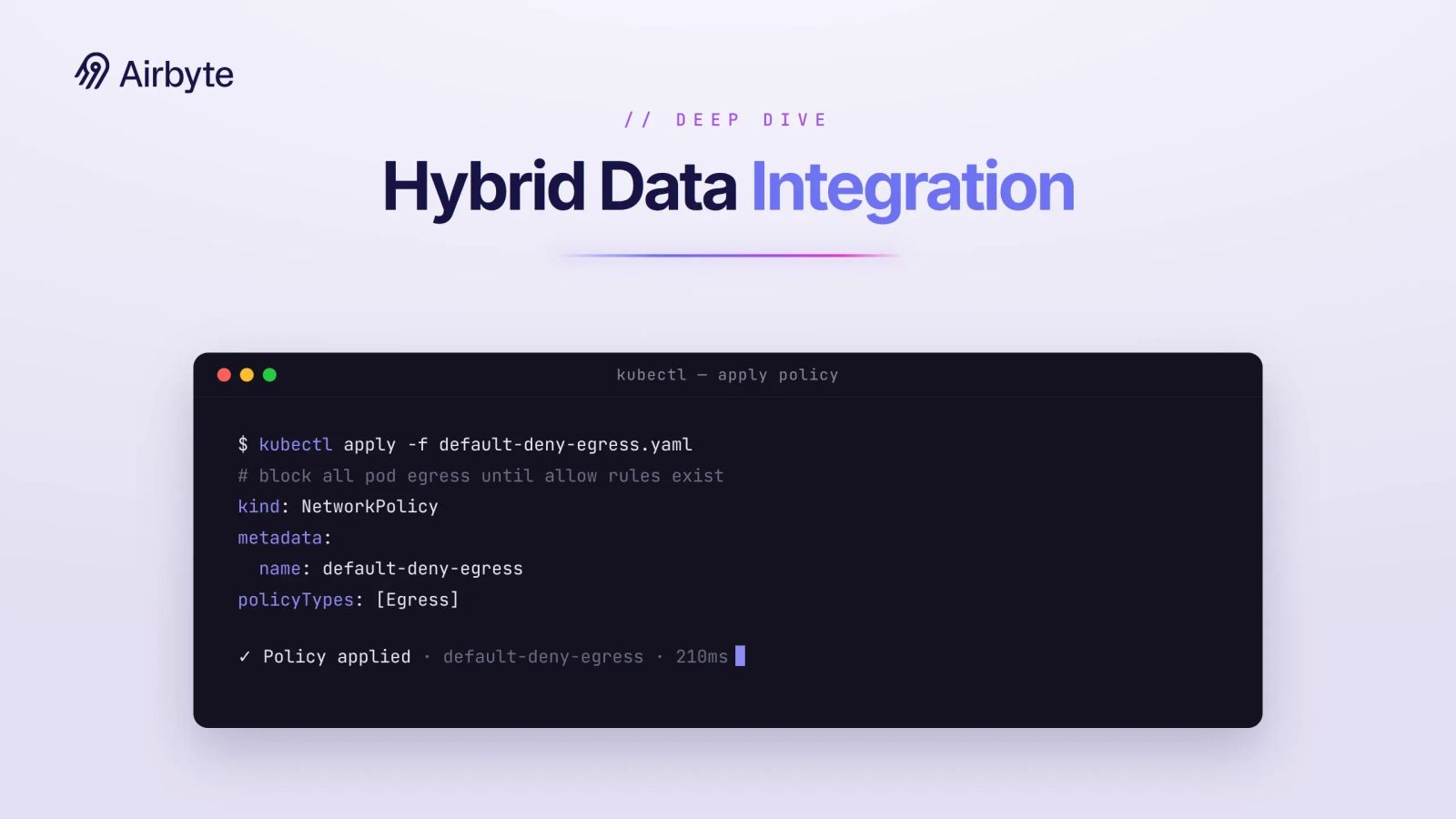
Together, these four pieces keep the control plane thin and the data plane in your hands. For Kubernetes-hosted data planes, a default-deny egress policy provides a practical starting point:
<pre><code>apiVersion: networking.k8s.io/v1
kind: NetworkPolicy
metadata:
  name: default-deny-egress
spec:
  podSelector: {}
  policyTypes:
    - Egress</code></pre>
This policy blocks all pod egress in the namespace, including DNS, until you add separate allow policies. Native Kubernetes NetworkPolicy supports IP and classless inter-domain routing (CIDR) controls at layer 4.
Fully qualified domain name (FQDN) allowlists require a DNS-aware egress proxy or compatible container network interface (CNI) extension in production deployments that must follow changing vendor hostnames. Also explicitly allow cluster DNS and the required control-plane endpoints before applying the policy.
This split architecture supports data sovereignty because you can control which region, or even which rack, each data plane runs in. Encrypt traffic in transit and test preview or diagnostic features to confirm that sensitive records stay outside the public control plane.
Consider a hypothetical manufacturing company syncing enterprise resource planning (ERP) inventory data to Snowflake for analytics. Its on-premises data plane captures CDC events from production tables, filters out employee details, and sends only product codes and quantities to the cloud warehouse. The control plane coordinates retries and sends alerts when jobs fail, while raw ERP records remain in the factory network.
Because machine timestamps, workstation assignments, or shift patterns may still identify workers, combine source filtering with least-privilege database accounts, network controls, and a privacy review.
What Are the Key Benefits of Hybrid Data Integration?
The key benefits are stronger control over data location, flexible scaling, unified governance, workload-based cost management, and operational continuity. Placing execution near each source can reduce movement and latency and let you apply policy before records cross an environment boundary.
The value of each benefit depends on how you configure workload placement, governance, and regional recovery.
What Challenges Does Hybrid Data Integration Solve?
Hybrid architectures address common infrastructure constraints, although they also introduce cross-environment networking, identity, observability, and incident-response duties.
Processing On-Premises Data Without Security Risks
A customer-managed data plane changes the trust boundary by initiating encrypted sessions from inside the network and applying extraction, filtering, or de-identification close to the source. That design reduces inbound exposure.
A zero-trust approach still requires you to deny traffic by default and allow only required endpoints. It also means authenticating workloads per session, rotating credentials, and redacting logs. Verify separately whether data previews or support tools can return record contents through the established connection.
A cloud-only platform requires an open network path or replicated data to process records that live behind your firewall. Policies or regulations that prohibit raw records from leaving the environment can make that architecture unsuitable.
Scaling Beyond On-Premises ETL's Limits
Depending on its architecture and configuration, traditional on-premises ETL may become more difficult to scale when you add SaaS sources or variable workloads. Each new connector may require your engineering time, firewall changes, credentials, capacity planning, and separate monitoring.
A hybrid control plane can standardize connector deployment and add compute near a source without requiring every workload to use the same infrastructure.
Consolidating Pipelines and Governance
A shared control plane can reduce duplicate pipeline definitions and keep governance policies consistent across independently operated data planes in every region. Regional teams remain accountable for region-specific identities, network policies, secret rotation, audit evidence, and incident procedures.
Reducing Maintenance Overhead From Schema Changes
You can reduce maintenance overhead by centralizing pipeline definitions, but schema evolution and retained-log dependencies still require source-specific monitoring and recovery procedures. For at-least-once CDC systems, retries can deliver a record more than once, so downstream transformations and warehouse merges must be idempotent.
Use schema contracts, lag alerts, replication-slot monitoring, and tested snapshot procedures to manage downstream consumers. The same mechanics matter when CDC feeds retrieval stores or AI data products, where stale or duplicated updates can affect the context available to downstream applications.
Consider a hypothetical European telecom that uses a hybrid integration platform. It streams IoT tower telemetry, merges the telemetry with SaaS customer relationship management (CRM) events, and pushes approved outputs into a cloud analytics warehouse. The design could avoid inbound access to the edge network and full duplicate stores. It would still need retention limits, reconnect behavior, idempotent writes, and a legal review of any customer identifiers included in telemetry or logs.
How Do You Choose the Right Data Integration Architecture?
The right architecture depends on where your data can legally sit and how many environments your pipelines already span.
- Hybrid (split control plane and data plane): Choose this when raw data must stay in a customer-controlled region across several environments. Centralized orchestration needs to justify local agents, networks, identities, and observability before you adopt it. Test control-plane outages, document what telemetry crosses each boundary, confirm audit rights, and make CDC writes idempotent.
- Cloud-only: Simpler when all data can lawfully reside in one supported region and the provider's sovereignty controls satisfy your requirements.
- Fully on-premises: Preferable when even metadata or remote vendor access is prohibited.
- Federated or data-space: Suits inter-organizational sharing where centralized replication is legally infeasible, though governance and interoperability remain less mature than the core protocol layer.
Depending on platform capabilities and governance, hybrid integration may also support policy-as-code that automates governance decisions, usage-based orchestration tuning, and multi-region deployments that meet data-residency and resilience requirements. These integration strategies can underpin data mesh and data fabric programs, but explicit placement decisions determine their benefit. Revisiting them as regulations and analytic demands evolve keeps the architecture aligned.
How Does Airbyte Flex Support Hybrid Data Integration?
You need one integration layer that respects data sovereignty without slowing you down. Airbyte Flex applies the architecture described above through the following capabilities:
- Cloud-managed control plane: Handles scheduling, monitoring, and lineage.
- Customer-managed data planes: Run extraction and loading inside your virtual private cloud (VPC), on-premises server, or isolated cluster.
- Outbound-initiated networking: Uses an HTTPS connection to the control plane.
- External secret managers: Flex pulls credentials from Vault or AWS Secrets Manager instead of storing them in plain text.
- Connector catalog: 700+ connectors run unchanged across data planes, so a hybrid deployment gets the same catalog as Airbyte Cloud.
Airbyte operates the control plane. The data plane, along with your records, credentials, keys, and compute, runs in your environment. Some metadata, such as cursor and primary-key values, still sits in the control plane.
The open-source foundation lets you inspect and operate the data-movement code itself, so sovereignty is a property of the architecture rather than a promise in a contract. The same replicated records are what an in-boundary retrieval stack indexes, so agent reads inherit the boundary and access controls the pipeline already enforces.
Across the platform, Airbyte moves 26 billion records daily for 7,000+ companies. Deployment fit still depends on whether Flex's workload placement, networking, secret management, and regional operations match your requirements.
What Should You Do Next With Hybrid Data Integration?
Start by documenting where processing, logs, credentials, and support access reside, then map each workload to the security, compliance, latency, and scale requirements that determine its placement. Test control-plane outages, telemetry boundaries, and idempotent CDC writes in a pilot before expanding across regions, and revisit those placement decisions as data-residency rules and analytic demands evolve.
Airbyte supports this kind of deployment through Airbyte Flex, which keeps orchestration in a cloud-managed control plane while your data, credentials, and compute stay inside your own environment.
Get a demo to see how Airbyte Flex fits your hybrid data integration requirements.
Frequently Asked Questions
What Is the Difference Between Hybrid Data Integration and Traditional ETL?
Traditional ETL may run primarily on-premises or in the cloud, with deployment location, processing style, latency, and data movement determined by its architecture and configuration. Hybrid data integration makes deployment location a per-data-plane design choice while a shared control plane manages those deployments. Latency, security, and compliance still depend on your implementation.
Can Hybrid Data Integration Help With GDPR and HIPAA Compliance?
You can use a correctly implemented hybrid architecture to support GDPR and HIPAA compliance, but processing locality alone is insufficient. Metadata, job logs, IP addresses, user identifiers, schema information, diagnostic payloads, and remote support access may all constitute personal data and trigger transfer requirements. To treat output as de-identified under HIPAA Safe Harbor, you must remove required identifier categories, including sub-year dates, IP addresses, and device serial numbers. You must also lack actual knowledge that the remaining information could identify a patient. Live vitals with precise timestamps or high-fidelity physiological waveforms may instead require an Expert Determination or a business associate agreement with the cloud processor.
How Does Hybrid Data Integration Reduce Costs Compared to Cloud-Only Platforms?
Hybrid approaches can cut costs by moving only the data you need, avoiding full-database replication, and processing data locally before sending aggregated results to the cloud. You may also reduce duplicate storage, cloud egress, and bandwidth fees, because source data stays in place while only processed outputs move between environments. Your actual savings depend on provider pricing, local infrastructure, staffing, and the cost of operating customer-managed data planes.
What Happens to Your Pipelines During a Regional Outage?
The outcome depends on where scheduling state lives and how workers reconnect. Already-running workloads may continue on local compute. A cloud control-plane or polling-connection outage can prevent new scheduled runs from starting, leaving runs scheduled, late, or reported as running until connectivity returns. Heartbeat-based replacement can start a second worker while the original remains active on a partitioned network, so use idempotent writes, deduplication keys, or fencing controls. Place control and data-plane dependencies in separate regions when supported, and test reconnect and failover behavior.

Integrate with 700+ apps using Airbyte
Move data from 700+ sources into warehouses, lakes, and beyond. Set up pipelines in minutes with pre-built connectors and the Connector Builder.