How to load data from Twitter to Teradata
Learn how to use Airbyte to synchronize your Twitter data into Teradata within minutes.


































Building your pipeline or Using Airbyte
Airbyte is the only open source solution empowering data teams to meet all their growing custom business demands in the new AI era.
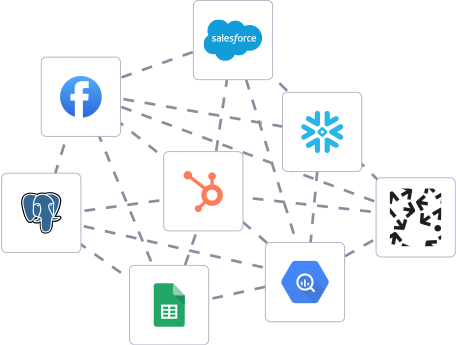
Building in-house pipelines
- Inconsistent and inaccurate data
- Laborious and expensive
- Brittle and inflexible
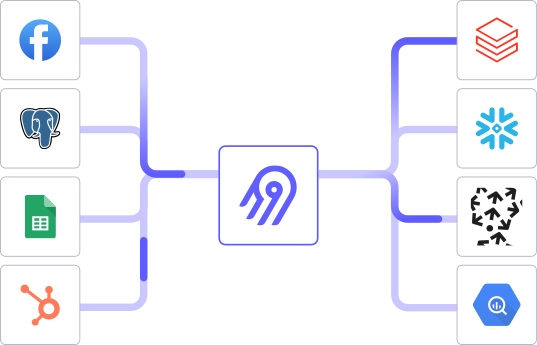
After Airbyte
- Reliable and accurate
- Extensible and scalable for all your needs
- Deployed and governed your way
Start syncing with Airbyte in 3 easy steps within 10 minutes


Take a virtual tour
Demo video of Airbyte Cloud
Demo video of AI Connector Builder
Setup Complexities simplified!

Simple & Easy to use Interface
Airbyte is built to get out of your way. Our clean, modern interface walks you through setup, so you can go from zero to sync in minutes—without deep technical expertise.

Guided Tour: Assisting you in building connections
Whether you’re setting up your first connection or managing complex syncs, Airbyte’s UI and documentation help you move with confidence. No guesswork. Just clarity.

Airbyte AI Assistant that will act as your sidekick in building your data pipelines in Minutes
Airbyte’s built-in assistant helps you choose sources, set destinations, and configure syncs quickly. It’s like having a data engineer on call—without the overhead.
What sets Airbyte Apart
Modern GenAI Workflows
Streamline AI workflows with Airbyte: load unstructured data into vector stores like Pinecone, Weaviate, and Milvus. Supports RAG transformations with LangChain chunking and embeddings from OpenAI, Cohere, etc., all in one operation.
Move Large Volumes, Fast
Quickly get up and running with a 5-minute setup that enables both incremental and full refreshes for databases of any size, seamlessly scaling to handle large data volumes. Our optimized architecture overcomes performance bottlenecks, ensuring efficient data synchronization even as your datasets grow from gigabytes to petabytes.
An Extensible Open-Source Standard
More than 1,000 developers contribute to Airbyte’s connectors, different interfaces (UI, API, Terraform Provider, Python Library), and integrations with the rest of the stack. Airbyte’s AI Connector Builder lets you edit or add new connectors in minutes.
Full Control & Security
Airbyte secures your data with cloud-hosted, self-hosted or hybrid deployment options. Single Sign-On (SSO) and Role-Based Access Control (RBAC) ensure only authorized users have access with the right permissions. Airbyte acts as a HIPAA conduit and supports compliance with CCPA, GDPR, and SOC2.
Fully Featured & Integrated
Airbyte automates schema evolution for seamless data flow, and utilizes efficient Change Data Capture (CDC) for real-time updates. Select only the columns you need, and leverage our dbt integration for powerful data transformations.
Enterprise Support with SLAs
Airbyte Self-Managed Enterprise comes with dedicated support and guaranteed service level agreements (SLAs), ensuring that your data movement infrastructure remains reliable and performant, and expert assistance is available when needed.
What our users say

Raman Singh

Predictable, straightforward pricing model that simplified budgeting and significantly reduced overall spend

Chase Zieman

“Airbyte helped us accelerate our progress by years, compared to our competitors. We don’t need to worry about connectors and focus on creating value for our users instead of building infrastructure. That’s priceless. The time and energy saved allows us to disrupt and grow faster.”

Rupak Patel

"With Airbyte, we could just push a few buttons, allow API access, and bring all the data into Google BigQuery. By blending all the different marketing data sources, we can gain valuable insights."
How to Sync to Manually
Step 1: Set Up a Twitter Developer Account
Begin by creating a Twitter Developer account to obtain access to Twitter APIs. Visit the Twitter Developer portal, create an account, and set up a new project. This will provide you with the necessary API keys and tokens required for accessing Twitter data.
Step 2: Write a Python Script to Extract Data
Use Python to interact with the Twitter API. Install the `tweepy` library to facilitate API interactions. Write a script that authenticates with Twitter using your API keys and tokens, and fetch the desired data (such as tweets, user profiles, etc.). Ensure your script handles authentication, error checking, and rate limiting as per Twitter API guidelines.
Step 3: Prepare the Data for Loading
Once you've extracted the data, transform it into a format suitable for loading into Teradata. Common formats include CSV, JSON, or fixed-width text files. Use Python libraries like `pandas` to clean and format the data. Ensure the data is well-structured and free from any inconsistencies.
Step 4: Set Up Teradata Environment
Ensure you have access to a Teradata environment. This includes having the necessary credentials and access permissions to create tables and load data. Install the Teradata Tools and Utilities (TTU) package on your local machine to facilitate data loading processes.
Step 5: Create Target Tables in Teradata
Using SQL, create the necessary tables in Teradata to hold the data you plan to import. Define appropriate data types and structures to match the format of your extracted Twitter data. Use the Teradata SQL Assistant or similar tool to execute your SQL commands.
Step 6: Load Data into Teradata Using BTEQ Script
Use Teradata's BTEQ (Basic Teradata Query) utility for loading data. Write a BTEQ script that uses the `.IMPORT` command to load your formatted data file into the target Teradata tables. Execute the script from your command line or terminal, and monitor the process for any errors or issues.
Step 7: Verify Data Integrity
Once the data load is complete, verify that the data in Teradata matches your source data from Twitter. Run SQL queries to check row counts, data accuracy, and integrity. Ensure that all data fields have been correctly populated and there are no discrepancies.
By following these steps, you can effectively move data from Twitter to Teradata without relying on third-party connectors or integrations.