Hybrid Cloud vs Multi Cloud for Data Workloads
Compare hybrid cloud vs multi cloud on compliance, egress cost, complexity, lock-in and team skills, plus a framework for placing data workloads.
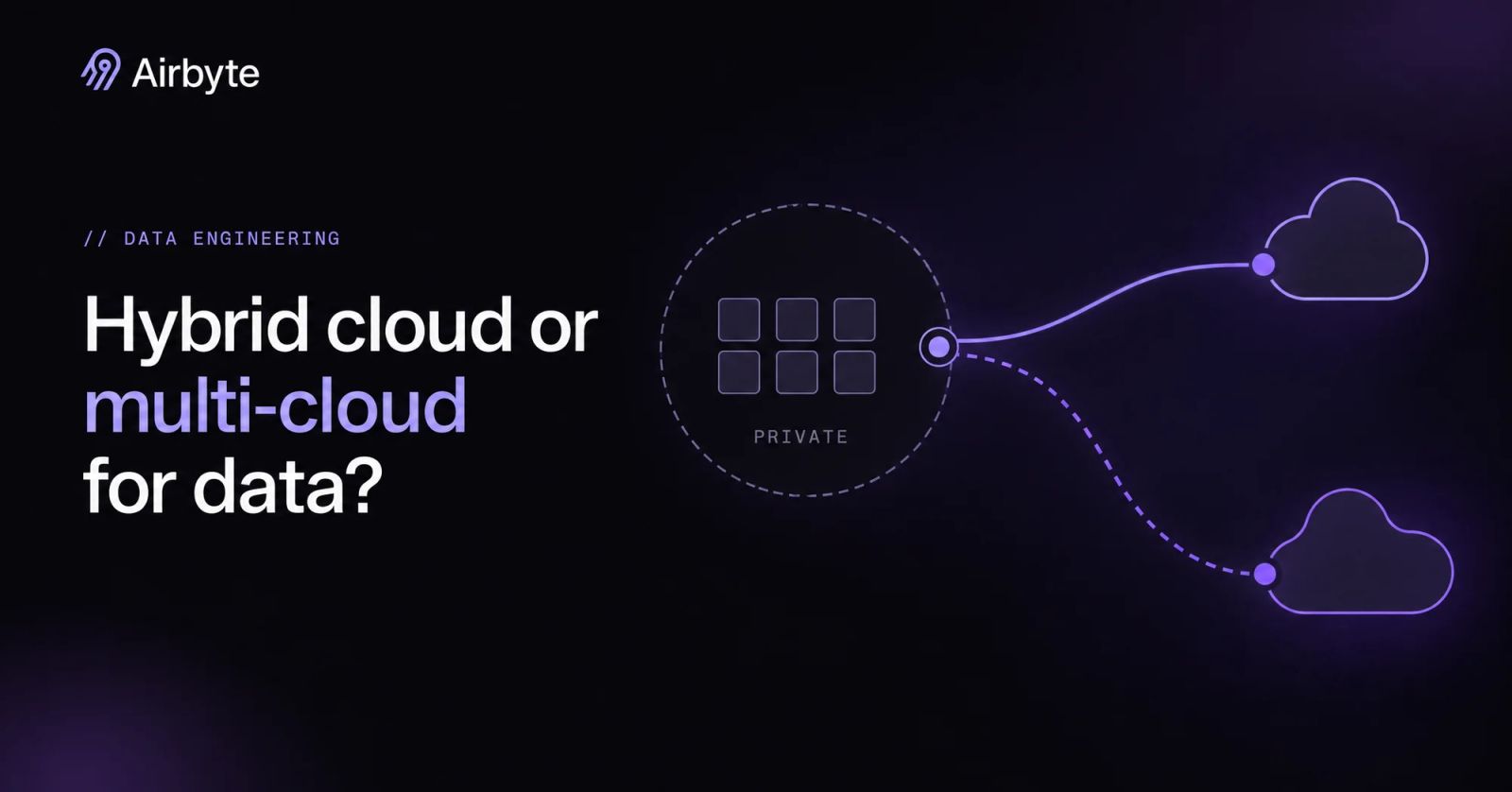
Hybrid cloud combines on-premises or private cloud infrastructure with at least one public cloud into one integrated, managed environment, while multi-cloud runs workloads on two or more public cloud providers such as AWS, Azure and Google Cloud. The core distinction is deployment location and the private-public mix versus the number of providers, and the two combine as hybrid multi-cloud when an on-premises estate connects to several public clouds. For data workloads, each added provider moves risk rather than removing it, bringing another egress meter, identity model and set of compliance evidence. Decide by data location first, and be suspicious of multi-cloud bought as a lock-in hedge, because egress fees and duplicated tooling cost more than the bargaining power they buy.
Summary
- Treat hybrid cloud as a data location decision and multi-cloud as a provider selection decision, because they answer different questions.
- Pick hybrid when residency rules or contracts fix where records may be processed.
- Before buying multi-cloud as a lock-in hedge, price the cross-cloud egress, the split spend commitments and the second copy of monitoring and security tooling.
- Plan for a hybrid end state with room for more than one public provider, since most organizations already run hybrid and few run public multi-cloud alone.
- Fix where the replication data plane runs first, then add providers one workload at a time.
Learn more about Hybrid Deployment
What Is Hybrid Cloud?
Hybrid cloud starts from data that has to stay somewhere you control. Hybrid cloud joins a composition of distinct cloud infrastructures, whether private, community or public, through technology that lets data and applications move between them while the environments stay separate, as when a workload bursts into the cloud for extra capacity. What turns a data center and an AWS account into hybrid cloud is the binding layer: shared networking, identity, management and data movement that let the two sides run as one environment.
Data workloads show what that binding layer has to carry. A bank that keeps its core ledger in an on-premises Oracle or Postgres database can stream CDC events, with account numbers hashed, into Snowflake on AWS for fraud analytics. The transactional system never moves. The replication path, where it runs and what it is allowed to send, becomes the hybrid architecture.
The engineering work therefore sits at the boundary rather than inside either environment. Someone has to own the network route between the data center and the cloud region, the credentials the pipeline holds, and the decision about which columns leave the building.
What Is Multi-Cloud?
A second provider needs a workload-level reason, such as BigQuery for analytics, a specific GPU fleet, or a managed database your team already depends on. Multi-cloud means running workloads on two or more public cloud providers; that provider choice leaves the question of where regulated data may live unresolved. Around 90% of enterprises rely on multiple cloud services, and organizations that invest unevenly in connectivity to and between those clouds face budget strain.
Connectivity budgets must also account for the private infrastructure behind the public-cloud estate. Of 753 surveyed cloud decision-makers, 73% run hybrid cloud and only 14% operate exclusively across public clouds without a private cloud, so include connections to private infrastructure in your integration plan.
Several clouds used by separate teams still do not add up to a multi-cloud strategy. Multi-cloud adoption often comes from mergers and SaaS sprawl and decentralized teams rather than deliberate design.
Without deliberate design, interoperability can defeat the investment: organizations expecting multicloud results miss them when their clouds cannot work together. When marketing analytics sits in Google Cloud because one team chose it and finance runs on Azure because another did, the company carries multi-cloud costs without a plan for moving data between them.
How Do Hybrid Cloud and Multi-Cloud Compare?
Seven dimensions separate the two models for data workloads:
When regulation fixes deployment location and data control, the other five rows become costs to budget for rather than options to weigh.
How Do Hybrid Cloud and Multi-Cloud Handle Compliance and Data Residency?
Residency is a property of the architecture: where the data plane runs, where credentials sit and which network paths exist. Hybrid keeps sensitive records inside a boundary you own and gives you one place to enforce policy. Multi-cloud splits the same policy across each provider’s IAM, key management, logging and audit evidence, and every split is a place where configurations can diverge. Each major regime puts a different kind of weight on that split:
- HIPAA: A cloud provider that stores ePHI is a HIPAA business associate even when it holds no encryption key, so each provider in the estate needs a business associate agreement and a check of which of its services are covered.
- PCI DSS: Version 4.0 requires tracking which requirements each third-party service provider manages, which the entity manages and which are shared, so a provider’s attestation covers only its share and the rest of the evidence stays with you.
- GDPR transfers: The EU General Court upheld the EU-US Data Privacy Framework adequacy decision on September 3, 2025, which keeps transfers to participating US companies lawful but leaves your own residency policy to enforce.
- French health data: Health data hosting rules require health data stored only in the EEA, which rules out any provider region outside the EEA for those records.
- DORA: In active enforcement since January 17, 2025, DORA requires financial entities’ ICT contracts to specify locations where functions run and data is processed.
Provider sovereign regions narrow the distance between the models without closing it. The AWS European Sovereign Cloud launched on January 15, 2026 in Brandenburg, Germany, physically and logically separate from other AWS Regions.
Germany’s financial supervisor still doubts whether providers can legally deliver sovereign cloud commitments, and tells firms to check foreign authority access and central update control by parent companies. Hybrid control has a price of its own. You own physical security, patching and audit evidence for the on-premises side, and a regulator will ask for that evidence as readily as it asks a cloud provider for an attestation. That operational load shows up next in the budget.
How Do Hybrid Cloud and Multi-Cloud Costs Compare?
Budget for egress, split commitments and duplicated tooling before choosing a second provider; its service price sheet does not capture those costs. For a pipeline copying CDC and snapshot data from US East (Ohio) into another provider’s warehouse over the public internet, model monthly outbound volume, free transfer allowances and per-request charges together.
From US East (Ohio), AWS list prices for egress are $0.09 per GB for the first 10 TB of monthly internet transfer, $0.085 per GB for the next 40 TB and $0.07 per GB for the 100 TB after that, against $0.02 per GB to US West (Oregon) inside AWS. The destination and route therefore change the transfer budget even when the copied dataset stays the same.
A 10 Gbps AWS Interconnect multicloud link to Google Cloud’s N. Virginia region lists at $12.33 an hour, or $9,000.90 for a 730-hour month, with no per-GB charge on the AWS side and Google billing its side separately. Compare that fixed connection cost with expected traffic: sustained replication and occasional copies need different cost models.
Your team buys commitment discounts separately from each provider, so it must size, track and renew separate commitments. Your engineers also configure each provider’s monitoring integration, IAM policies, cost-allocation tags, backups and security-posture checks; a second provider adds ongoing work alongside the transfer bill.
Repatriation and Exit Costs
Repatriation is common, but it changes the cost structure. Organizations moved about 18% of PaaS workloads from public cloud back on-premises over the past year, driven mainly by performance (36%) and security (30%). On-premises hardware is capital spend depreciated over several years, while cloud spend is operating expense that tracks use, including idle use. Hardware refresh, facilities and staff drive the on-premises side; idle capacity and egress drive the cloud side.
Exit relief applies to leaving a provider, not to running two. AWS waives data transfer out only when a customer moves all data off AWS or off a specific service, issues the waiver as a credit after approval, and can charge it back if the transfer served another purpose.
Regulation removes the exit fee on a fixed date but leaves the running cost alone. The EU Data Act bars switching charges from January 12, 2027, but continuing replication across providers still needs its own transfer budget.
How Do Hybrid Cloud and Multi-Cloud Differ in Integration Complexity and Team Skills?
Connectivity Between Environments
Hybrid and multi-cloud estates connect over site-to-site VPN, SD-WAN or dedicated circuits, and the dedicated circuits carry fixed hourly or monthly prices. A 10 Gbps Direct Connect port costs $2.25 an hour outside Japan, plus per-GB data transfer out. A metered ExpressRoute Standard circuit at 10 Gbps carries a fixed monthly price, with outbound data billed separately. Those fees accrue whether or not a pipeline moves data that hour.
Circuits that join two public clouds follow the same fixed-fee pattern. Google’s Cross-Cloud Interconnect at 10 Gbps costs $5.60 an hour per circuit, plus VLAN attachments and egress. A hybrid estate buys one of these circuits to reach its data center. A multi-cloud estate buys one per provider pair and maintains the routing, IP plans and failover between them, so its fixed connectivity bill and routing workload grow with each provider pair.
Management Platforms for Hybrid and Multi-Cloud
Each provider sells two kinds of platform, and they map to different models. For hybrid, providers ship their cloud into your building: AWS Outposts racks are AWS-owned and AWS-managed hardware installed in a customer-managed site, so the hardware arrives under AWS ownership while the building stays yours.
Product names in this category have shifted, which matters before you sign for one. Microsoft’s on-premises stack is now Azure Local, which Microsoft renamed from Azure Stack HCI, so older contracts and documentation can describe the same product under its earlier name.
Google sells Google Distributed Cloud, in connected and air-gapped versions, for on-premises and edge sites. Before planning a hybrid build around any of these platforms, confirm the product is still sold under that name.
For multi-cloud, providers extend their control plane over other clouds. Azure Arc projects external machines and clusters from AWS, Google Cloud and on-premises sites into Azure Resource Manager, where each one appears as an Azure resource.
Google takes the same approach from the other side: GKE attached clusters register EKS and AKS clusters for management from Google Cloud. Kubernetes is the shared substrate in both cases. None of these platforms moves your data between environments; they manage compute and policy, and replication still needs its own runtime that sits next to the sources.
In hybrid, one scheduler can reach on-premises and cloud sources through that replication runtime. In multi-cloud, teams either run each provider’s native scheduler or run a neutral orchestrator such as Airflow or Dagster, which needs network paths and credentials into every cloud.
Team Skills for Hybrid and Multi-Cloud
Skills shortages compound with every platform added. Lack of training is a top cloud native challenge for 36% of organizations, second to cultural change at 47%.
Cloud security is the skill hiring managers prioritize most, at 29%. Hybrid needs network engineers, hardware lifecycle management, on-premises database administration and depth in one public cloud. Multi-cloud needs fluency in several IAM models, per-provider cost management and security engineers who can compare controls across consoles. A small team can usually staff one of those profiles, rarely both.
When Should You Use Hybrid Cloud or Multi-Cloud?
Most companies reach different answers for different data, depending on the workload and the team that runs it. Start with the data that has the least freedom to move.
Regulated Workloads
Regulated records favor hybrid when a residency rule or contract requires processing inside your own boundary. Put the replication data plane there and send only masked, hashed or aggregated data to public cloud analytics. A second public provider needs a service-level justification strong enough to cover the added audit scope.
Latency-Sensitive Workloads
Latency-sensitive systems favor hybrid when the source lives on-premises, such as factory telemetry, trading systems or point-of-sale databases. Process close to the source and ship only the results. Splitting a transaction path across two providers adds a cross-cloud network hop to every request, which is the opposite of what these workloads need.
Bursty Workloads
Bursty compute is the oldest case for public cloud and the textbook case for hybrid bursting. Keep the data still: copy inputs once, run the batch in the cloud, write results back. A second provider earns its place only when the first cannot supply the capacity you need at the time you need it.
AI and Analytics Workloads
Choose AI compute with the cost of supplying current data in view. By 2030, more than 60% of enterprises are projected to run AI model work in one cloud against data held in another, up from under 10% today. For these workloads, replicate curated, governed tables on a schedule matched to the freshness the model needs, and apply access control before the data crosses.
Team Size and Migration Sequencing
A team of a few data engineers should run one public cloud plus whatever on-premises systems it cannot retire, and add a second provider only for a named service with a costed transfer plan. Hybrid multi-cloud is worth its overhead when regulated data and a provider-specific service have to coexist. When migrating, move the replication paths first, run old and new pipelines in parallel with record-count and checksum comparisons, cut downstream consumers over, and only then retire the old pipelines and compute.
How Does Airbyte Help With Hybrid Cloud and Multi-Cloud Data Movement?
Airbyte Flex splits replication along the same line as the hybrid decision: who operates the software versus where the data runs. Airbyte operates the control plane while the data plane, along with your records, credentials, keys, and compute, runs in your environment, though some metadata such as cursor and primary-key values sits in the control plane. The data plane runs on EKS, GKE, AKS or on-premises infrastructure, and Airbyte manages orchestration and upgrades. Each workspace maps to one region and one data plane, so a multi-region estate runs as one instance with one workspace per region.
Flex keeps the whole feature set inside your boundary: the full catalog of 700+ connectors is available there, with CDC that reads database changes without locking production tables, schema change detection and propagation, RBAC and audit logging. You can assess sovereignty through data-plane placement and inspectable connector code alongside the contract terms. The governed tables Flex lands in your warehouse are the same ones AI applications can read, under the access controls and audit trail your analytics pipelines already use.
Should Data Location Decide Your Hybrid Cloud or Multi-Cloud Strategy?
Yes, data location should decide first, so start with a residency inventory before any provider decision. For each source system, record which regulation or contract governs it, where its records may be processed, and which downstream consumers need it at what freshness. Draw the data plane boundary from that inventory, then decide workload by workload whether a second public provider earns its transfer and tooling cost, and revisit the map whenever a new regulation, acquisition or AI use case moves a workload across the line.
Airbyte provides one platform, one connector catalog and one API across Airbyte Cloud, Airbyte Flex and Airbyte Core (open source), so your team can choose a deployment model around its residency requirements. Connectors follow the open Airbyte Protocol and run in Docker containers, so your team can fork them and control connector changes; the Terraform provider keeps connection configuration in version control across environments. Pricing differs by plan, so the deployment model you choose also sets how you pay: Standard and Plus use volume-based credits, Pro and Enterprise Flex use capacity-based pricing, and Airbyte Core is free to self-host.
Get a demo to see how Airbyte moves data across hybrid and multi-cloud environments without leaving your boundary.
Frequently Asked Questions
Is AWS a public or private cloud?
AWS is a public cloud provider, but a provider’s name alone does not classify every deployment. For offerings such as Dedicated Hosts and Dedicated Local Zones, assess tenancy, physical location and operating responsibilities before assigning a compliance category.
Is a private cloud the same as on-premises infrastructure?
Private cloud describes exclusive use by one organization, while on-premises describes physical location, so a private cloud can run in your own data center or in a provider’s facility as hosted private cloud. Ownership and day-to-day operation can also sit with a third party without the environment becoming public.
Does running Kubernetes make an application multi-cloud?
Not on its own: storage classes and volume drivers are provider-specific and volumes are usually tied to a zone. A workload that depends on a managed database or a provider identity service still has to be rebuilt on the second cloud.
Can a company move from hybrid cloud to multi-cloud later?
Yes, but the cost grows with everything you build first. Large datasets are slow and expensive to copy, applications written against proprietary managed services need rework, and multi-year commitments signed with the first provider keep billing whether or not workloads move.
Does a multi-cloud strategy improve disaster recovery for databases?
Only partially, because cross-cloud database replication is usually asynchronous and a failover can lose writes still in flight. A warm standby in a second cloud also means paying for compute, storage and transfer that sit idle most of the year. A backup restored into the second cloud avoids maintaining an always-on standby, but it lengthens recovery.

Integrate with 700+ apps using Airbyte
Move data from 700+ sources into warehouses, lakes, and beyond. Set up pipelines in minutes with pre-built connectors and the Connector Builder.