On June 9, 2026, Anthropic shipped Claude Fable 5 with a mandatory 30-day retention period for users but with no zero-retention option. Companies with zero-data-retention agreements suddenly had 30-day data retention agreements with the Claude model. There was no change to their architecture.
But there was a change to their policy page.
Three days later, the Commerce Department took the same model offline worldwide. The model stayed offline for 18 days.
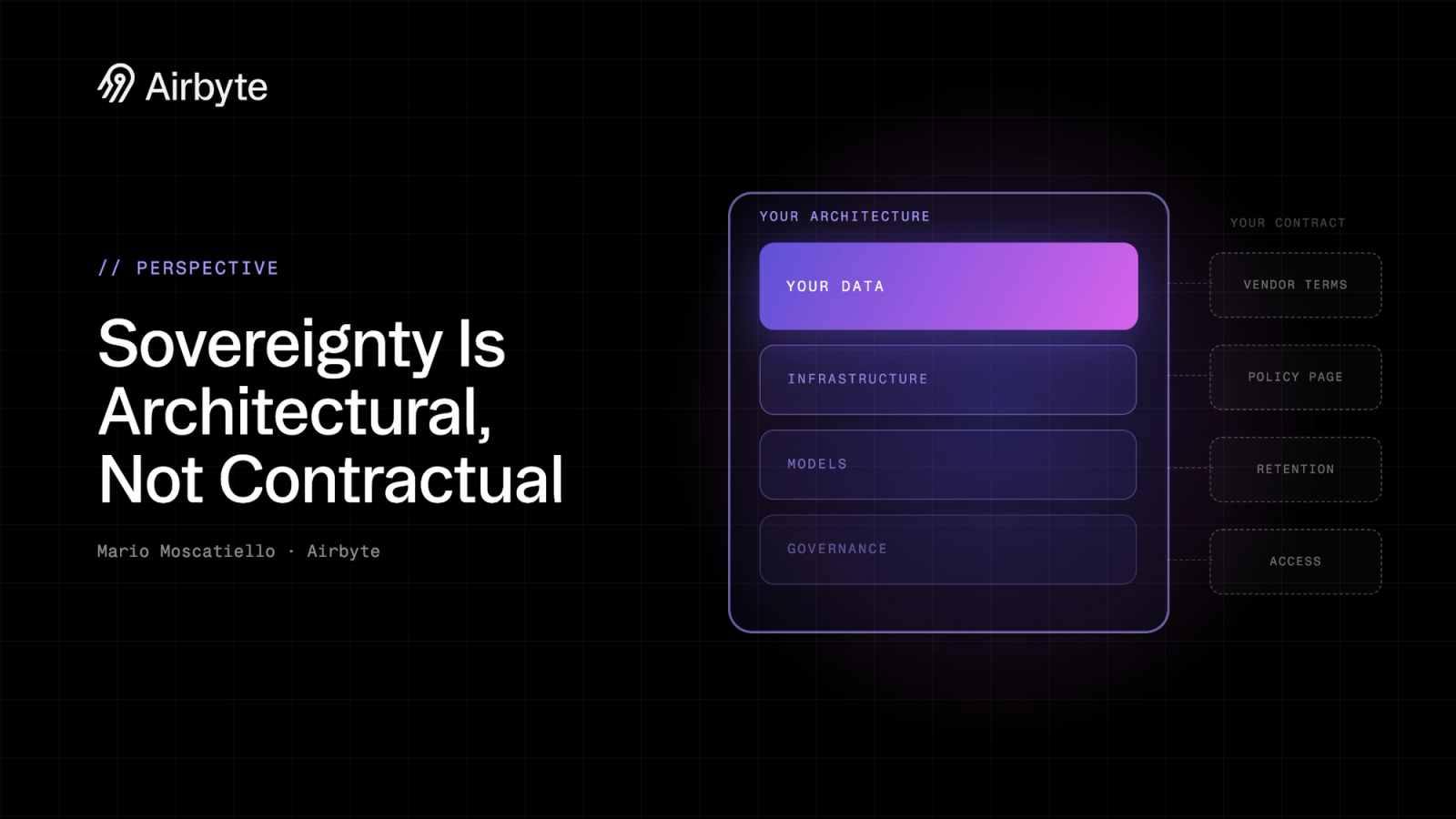
Two failures in one month, and the same lesson under both. Every enterprise that experienced June's whiplash had sovereignty on paper. What they didn't have was sovereignty in their architecture, and the difference between those two things is what this piece is about.
Two kinds of sovereignty Contractual sovereignty is a promise about where your data goes. It exists in your data processing agreement, your residency clause, your retention commitment. It is real in that lawyers can enforce it, and in that most companies will tell you that this is sufficient.
Architectural sovereignty is fundamentally different. Since the data never leaves your boundary, there is nothing to promise. Your vendor can’t retain data that it doesn’t hold. Regulators can’t force your vendor to reveal data about your topology because it’s within your boundary.
It comes down to human promises versus system topology. A promise can be amended by the party that made it. Topology can’t be amended from afar.
Most enterprises believe they have the second kind. Four questions reveal which kind they actually have.
The four questions Where does the data live? Not where the contract says it lives, but where the actual physical location of the data, including replicas, embeddings, and caches.
Where does it move? Identify every instance when the data leaves one system to enter another, whether via API calls or model providers, the data moves across a boundary.
What touches it in transit? These are the parties that facilitate or leverage data in transition. Each has its own terms and conditions, and the terms can change.
Who can revoke access, and how fast would you know? Authority and ownership must be established, and remain under the organization’s control. When vendors control access, your organization remains vulnerable.
When most businesses run this test, they find the majority of their sovereignty is in fact contractual. The data may live in your account, but you don’t control it. The provider owns the terms of data retention and access, while the model is a black box run from someone else’s environment.
Unless you can audit your infrastructure, you don’t have sovereignty.
Failure mode one: the terms change The Fable 5 model change in retention is the cleanest example of this failure mode. Anthropic's own support documentation states that Mythos models have a 30-day retention mandate on all platforms, that there is no zero-data-retention agreement for these models, and that the existing ZDR agreements do not apply to this model.
Jessica Eaves Mathews , an AI lawyer who analyzed the change, stated: “If your organization previously had a ZDR agreement with Anthropic, that agreement does not apply to Fable 5 traffic. This is a policy change that overrides existing enterprise commitments for this specific model class.”
An enterprise commitment, negotiated and signed, overridden for a new model class by policy. Companies that had a ZDR agreement with Anthropic are no longer compliant with local regulations, and many of them had no warning.
Failure mode two: the access disappears On June 12, the Commerce Department ordered Anthropic to limit foreign-national access to Fable 5 and Mythos 5 under an export-control authority that had never before been applied to a commercial AI model. The only way to comply was to disable the models worldwide. They were back online on June 30.
Anthropic opposed the directive publicly, but had no choice but to comply. Their customers were the ones who lost access to the new model. And there is no guarantee that this will never happen again.
The Center for Strategic and International Studies drew the conclusion buyers are now drawing themselves: uncertainty over durable access to any specific US model will push customers toward options they can run on infrastructure they own.
What architectural sovereignty looks like I think sovereignty is best handled at the data layer, well before the models come into play.
Your entire data infrastructure can be built inside your environment. On top of this, your team can deploy open source models locally and build out their own inference capabilities. This is much more challenging than relying on managed service from a frontier lab, of course. But I believe that this infrastructure is what enterprises are moving towards, and it will become increasingly more widespread and easier to implement.
"But our vendor is trustworthy" Probably true, and beside the point. Nobody at Anthropic set out to break enterprise commitments in June. The retention change came from safety policy. The shutdown came from a government directive the vendor fought.
Trust isn’t the relevant variable in this scenario. Terms are variable, and subject to the whims of external forces.
Run the four questions against your current stack. Where the answer routes through someone else's policy page, you've found the gap between the sovereignty you have on paper and the sovereignty you'd have when the next policy page changes.