Hybrid Cloud Management Software for Distributed Pipelines
A six-criteria scorecard for evaluating hybrid cloud management software for distributed pipelines, covering execution, observability, audit, and failover.
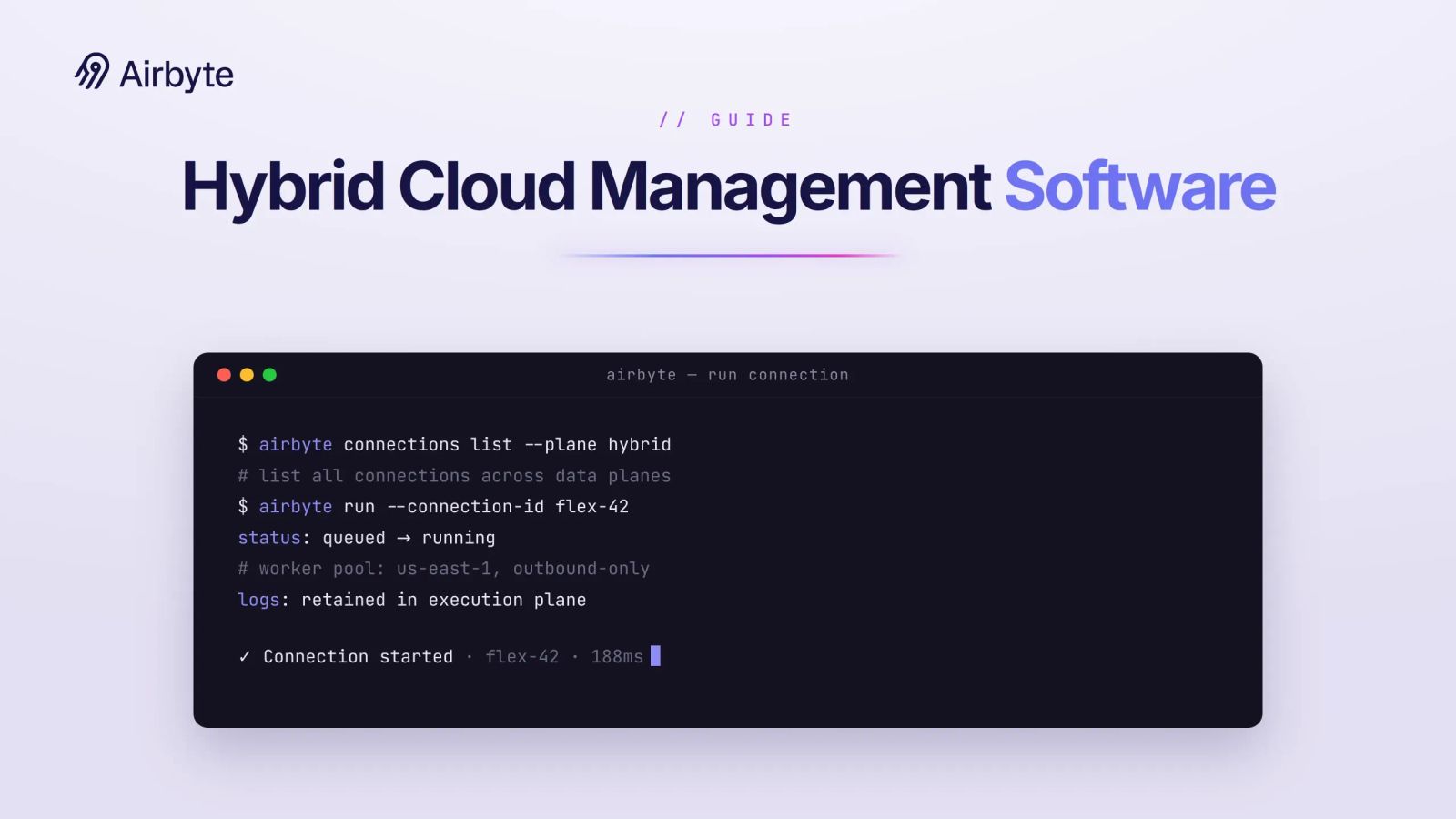
The hardest hybrid pipeline decision is whether the deployment can preserve your operating model when a network boundary, regulatory requirement, or vendor outage disrupts normal orchestration. Connector-list length does not answer that question. A platform may demonstrate broad feature coverage while leaving key operating behavior undocumented. You may still be unable to explain where sensitive logs went, why queued work disappeared, or how configurations move to another footprint. You should therefore judge the architecture by the operational consequences it creates, especially during audits, connectivity failures, upgrades, and regional changes.
TL;DR
- Hybrid cloud management software for distributed pipelines governs pipeline execution across planes; infrastructure cloud management platforms that provision servers and meter billing are a different category.
- The plane that holds credentials, task logs, metadata, and the scheduler sets your compliance posture before any feature does.
- Make control-plane outage behavior a threshold criterion and require written evidence before scoring candidates.
- Evaluate candidates across execution management, observability, policy and audit, failover and recovery, cost controls, and lifecycle.
What Does Hybrid Cloud Management Software Do for Distributed Pipelines?
Hybrid cloud management software for distributed pipelines is the layer that schedules, observes, governs, and recovers pipeline execution across a cloud control plane and customer-controlled data planes. Managed objects include connectors, schemas, schedules, and lineage. The hybrid control plane pattern provides the vocabulary: a vendor or central team runs orchestration, while tasks, credentials, and records stay within your boundary.
An infrastructure cloud management platform (CMP) primarily manages different objects. The Cloud Standards Customer Council's practical guide to CMPs defines a CMP as a product with self-service interfaces, system-image provisioning, metering and billing, and policy-based workload improvements. A CMP can tell you what a virtual machine (VM) costs per hour. By itself, it may not tell you that a Change Data Capture (CDC) stream stopped emitting or that a source table grew a column overnight. When a CMP vendor describes "hybrid cloud management," verify whether the product can see and manage your pipelines.
Which Execution and Observability Capabilities Should You Require?
For models that use outbound-only communication, evaluate how many workers you install per pipeline, whether the control plane can route tasks to a named worker group, and which metadata crosses the boundary. Treat the rest of the feature sheet as secondary.
Outbound-only connectivity is table stakes, not proof of isolation. Many documented hybrid execution models use workers that initiate communication with a remote or central control plane. An execution environment may initiate Hypertext Transfer Protocol Secure (HTTPS) connections to a central site, and workers in polling designs request scheduled work from a hosted control plane. Evaluators often overstate what outbound-only connectivity guarantees because the worker still depends on a remote scheduler and sends state upstream. The pattern does not create an air gap.
Worker-to-pipeline ratio is where models diverge. If a worker design requires a separate installation for each CDC pipeline, then fifty CDC sources become fifty workers you patch. A worker-pool design lets one control plane route tasks to pools in a named region or network. Prefer that resource-pool topology unless you have a specific isolation reason to sprawl workers. Ask for the routing docs and count the installs you would own.
Task logs belong in the execution plane, not the control plane. For evaluation, assume task logs may carry query text, row counts, and sampled records. This puts them in the plane that executes the task. Don't stop the review there. How do execution-plane logs appear in the control-plane user interface (UI) when the execution environment accepts no inbound connections? How does a trace cross the boundary so you can tie a flow run ID to a pod trace in a separate Virtual Private Cloud (VPC)? Distributed pipeline observability covers the practices; for selection, get a written statement of every field that crosses the boundary and record any undocumented field as a finding.
These models may share an outbound communication pattern, but you should validate what each central control plane receives.
Prefer a model that keeps sensitive execution details in your boundary while preserving central visibility into status and recovery.
How Should Policy, Sovereignty, and Audit Requirements Shape Your Selection?
A cloud control plane survives your audit only if you can show which plane holds pipeline metadata and point to the configuration that keeps execution and credentials in your boundary. That proof must cover both normal operation and administrative access.
Metadata residency is its own compliance surface. Keeping records out of the control plane does not settle residency. Schema definitions, job configurations, query logs, and lineage graphs reveal table structure, join patterns, volumes, and processing frequency, and each can leave your boundary while records stay put. Metadata held by a control plane in another jurisdiction creates the same architectural question as records processed outside an approved region. Ask for the config line that pins execution location, and require per-workload credential isolation as described under workload identity controls.
Exit and provenance obligations extend that same boundary logic to the pipeline layer. The Digital Operational Resilience Act (DORA) has been actively enforced since January 17, 2025. For a pipeline platform, meeting its exit and transition requirements means exporting pipeline definitions, schedules, and connection configs in a form another tool can run. The European Banking Authority's single-rulebook questions and answers (Q&A) state that Article 28(3) applies without exception, even to entities on the simplified information and communication technology (ICT) risk management framework.
The European Union (EU) Artificial Intelligence (AI) Act generally became applicable on August 2, 2026. Article 10 of the AI Act guidance requires documentation of "data collection processes and the origin of data," along with the data-preparation work applied before a model ever sees the data, including annotation, labeling, cleaning, updating, enrichment, and aggregation. That lineage must survive every pipeline stage, so the store's location and export format are audit items. Require the lineage graph and the pipeline-as-code in a vendor-neutral export that feeds your unified compliance audits rather than relying solely on the vendor's UI.
Which Failover and Cost Controls Should You Test?
Test what queued and running tasks do when the control plane is unreachable. Also measure how much reporting traffic consists of metadata rather than data. Those answers expose operating risk that a connector-and-feature comparison will miss.
Published reliability data will not tell you how your workers reconnect after an outage. A recent outage analysis from the Uptime Institute found that outage rates declined for a fifth consecutive year, while external infrastructure failures such as fiber and connectivity issues were rising and more likely to cause extended disruptions. That trend makes distributed control-plane behavior an operational concern even when your own infrastructure remains healthy.
For a hybrid runtime, a healthy data plane does not guarantee access to its control plane. Your workers may remain healthy, but you still need to know whether they continue running the workflow they already hold. You also need to know whether queued tasks fire late or drop, whether a retry loop hammers the unreachable endpoint and amplifies egress, and how the control plane reconciles state when it returns. Undocumented reconnection semantics turn a vendor outage into unplanned downtime.
Send a written request that covers running tasks, queued tasks, and scheduled triggers. Require the vendor to specify:
- behavior when connectivity fails;
- the retry and backoff policy;
- the buffer limit at which the system drops state; and
- the reconciliation rule when connectivity returns.
Use the response to score the failover row. A vendor that answers with a status page link has scored that row without supplying the requested evidence.
Egress charges follow the reporting path, and that path is a design choice, not a fixed cost. For Amazon Web Services (AWS) workloads, AWS may bill traffic that a worker sends upstream as egress once you clear the free tier. Full modeling of hybrid pipeline costs is a separate exercise; the software question here is narrower. AWS charges $0.09 per gigabyte (GB) for the first 10 terabytes (TB) per month of internet egress after the free tier, a baseline for traffic that leaves the execution environment over the public internet. AWS's published Direct Connect pricing charges $0.02/GB for the same transfer, and that difference makes the reporting path and transfer volume material to your deployment model.
The criterion covers attribution and enforcement. Can the tool attribute egress-generating traffic and compute to a pipeline, workspace, or region? Can it cap that usage with concurrency limits? Also verify whether the control plane receives metadata only while logs stay in the execution plane by default. Ask for the cost attribution fields and the exact list of what reports upstream.
How Do You Score Candidates Across the Six Criteria?
A 3 requires a document you could hand an auditor; a demo of the same behavior earns at most a 2; a verbal assurance earns a 1; no answer is a 0. Adjust the row weights for your situation. Regulated teams weight failover and policy highest, while multi-cloud teams weight execution and cost. If you still need a broad shortlist of ETL platforms first, the hybrid ETL tools comparison is a starting point; score the survivors against the six rows.
Configuration also has to survive a footprint change, not just an outage. Pipeline definitions, schedules, and connection configs must export cleanly and re-import into a different footprint, using references instead of embedded secrets. Test the export on a live pipeline during the evaluation, then import it into a scratch environment. On upgrades, demand a stated compatibility window between control-plane and worker versions. The vendor must express that window in versions or months. Reject "always run latest" as an answer because it hands your in-boundary change control to the vendor's release calendar.
Score each candidate 0–3 per row using the evidence column and disregard unsupported claims in the sales deck.
A candidate should advance only when its documented evidence meets the thresholds you set for every high-priority row.
How Airbyte Flex Helps Manage Distributed Pipelines
Airbyte Flex is a hybrid deployment model: Airbyte runs the control plane while you control the data plane, so data, credentials, and compute stay in your own virtual private cloud or in-boundary environment. On the sovereignty spectrum, it sits between Airbyte Cloud and Self-Managed Enterprise.
For execution management, Airbyte Flex provides the full catalog of 700+ connectors with no gating by deployment model. One Airbyte instance can cover multiple regions through multiple workspaces, each mapped to exactly one region and one data plane, on AWS, Google Cloud Platform (GCP), and Azure. Airbyte serves 7,000+ companies moving 26 billion records daily, including 18% of the Fortune 500. During evaluation, test role-based access control, audit logging, and masking of personally identifiable information against your own evidence requirements.
The open-source foundation makes connectors and implementation details inspectable. Apply the scorecard separately to portability, control-plane recovery, and version compatibility, which inspectability alone does not establish.
That same boundary matters beyond pipeline audits. As AI agents and other internal AI workflows start pulling from the same source systems these pipelines replicate, the sovereignty question does not stop at the model. It starts at the connector layer. A deployment that already keeps execution, credentials, and logs in your boundary is infrastructure an AI initiative can build on, rather than a separate integration your security team has to review from scratch.
Where Should You Start?
Set your thresholds first, then score each candidate against the six criteria above, and reject unsupported claims from the sales deck. The evidence a vendor is willing to put in writing tells you more about their hybrid model than any feature comparison will.
Airbyte publishes its platform documentation openly, which lets you check Airbyte Flex against every row of that scorecard yourself instead of taking a sales claim at face value. Get a demo to see how Airbyte Flex supports governed hybrid deployment of distributed pipelines.
Frequently Asked Questions
How Do You Sequence Upgrades Between the Control Plane and Your Workers?
Apply the lifecycle criterion in the scorecard. Require the vendor to document which side upgrades first, how long it supports older workers, and what happens to in-flight runs during the gap.
Should You Treat Multi-Cloud and Hybrid as the Same Thing?
No. For this evaluation, treat them as different topologies with different routing, residency, and operating requirements. Scope the tool to the topology you run today.
Can You Cut Costs by Repatriating Part of a Pipeline?
Partial exits can create substantial transfer costs because data continues crossing the remaining cloud boundary. Price the transfer volume the split would create before you move one stage.
When Do Cloud Switching Fees Actually Disappear?
The answer depends on the governing law, effective date, provider terms, and whether a transfer qualifies as switching. Review those provisions before any renewal that extends across a regulatory change.

Integrate with 700+ apps using Airbyte
Move data from 700+ sources into warehouses, lakes, and beyond. Set up pipelines in minutes with pre-built connectors and the Connector Builder.