How To Build an On-Premise AI Server for Enterprise Data
An on-premises AI server is only sovereign if ingestion stays within the boundary. How to size GPUs, govern retrieval, and map EU AI Act and DORA rules to the build.
Most on-premise AI server projects get budgeted as a hardware purchase, and the sovereignty claim they were built to support fails elsewhere. The GPUs sit in your rack, the model weights never leave, and the pipeline feeding the index still stages records from your systems of record in a vendor-managed bucket on the way in. An auditor who asks where the organization processed those records gets two answers. Compute placement is the easy half of this build. The harder half is an ingestion path, a retrieval layer, and a logging model that hold the same boundary the hardware implies.
TL;DR
- Size on weights plus execution overhead. Key-value (KV) cache, activations, and framework overhead add 15 to 20 percent before context length and concurrency move the number again.
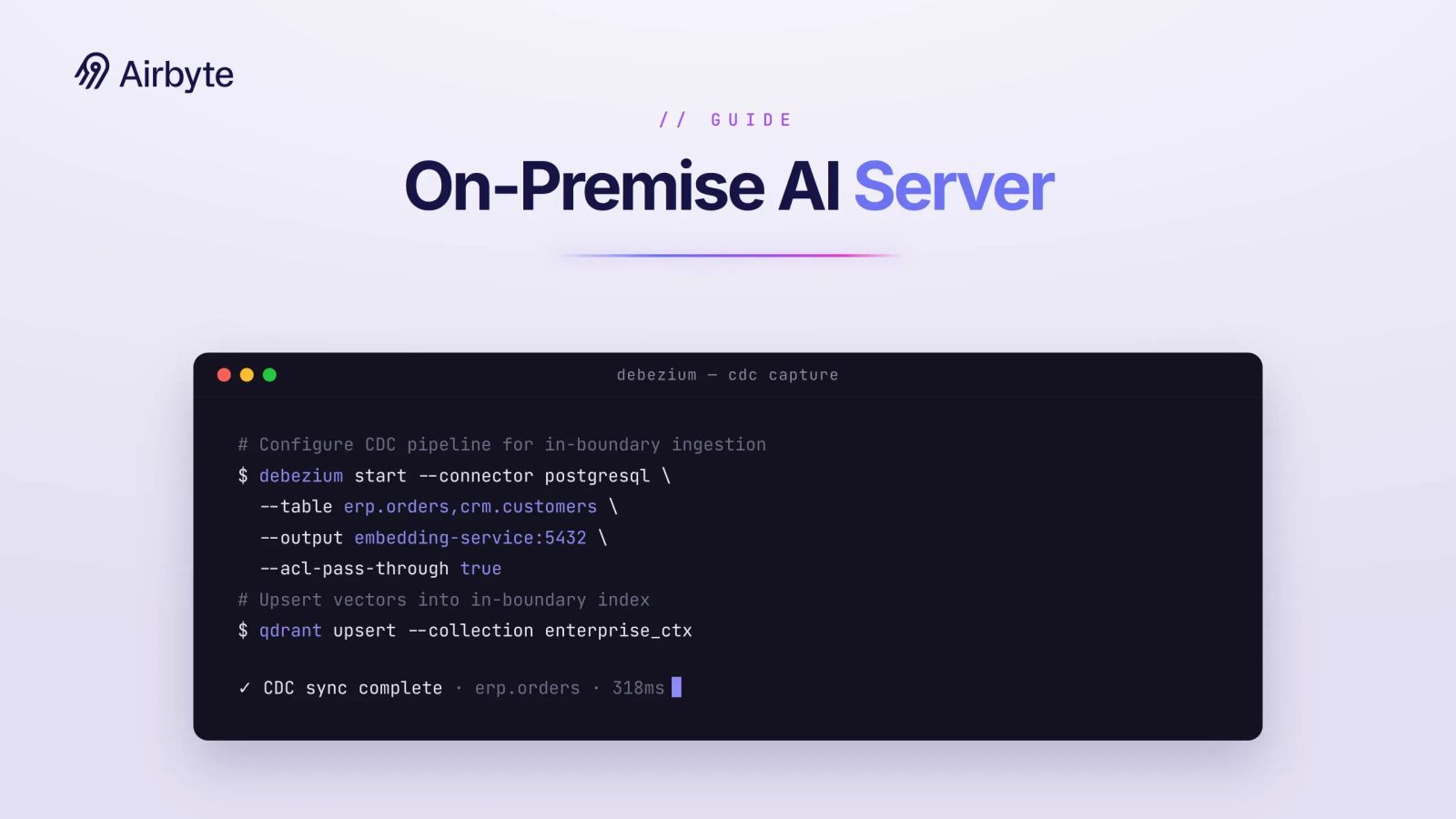
- Sovereignty is decided in the ingestion path, not the server room. Log-based Change Data Capture (CDC) into an in-boundary embedding service keeps records inside the trust boundary.
- Retrieval is an access control surface. Chunk-level access control lists (ACLs), verified identity claims as pre-filters, and redaction before embedding do work the source system cannot do for you.
- Erasure must reach the index, the embedding cache, and the generation logs, and fine-tuned artifacts are assessed separately.
- Compliance is a configuration decision. EU AI Act logging obligations, a Digital Operational Resilience Act (DORA) register entry, and model origin all narrow the build before any benchmark runs.
What Does an On-Premise AI Server for Enterprise Data Include?
An on-premise AI server for enterprise data is a single trust boundary holding graphics processing unit (GPU) compute, a governed ingestion path from your systems of record, a retrieval index, and controlled access from applications and agents to the context in that index. The GPU host, the vector index, and the orchestration framework are commodity components. You can buy any of them, and you can replace any of them. The ingestion path deserves scrutiny, because where it runs decides whether records leave the boundary at all.
Consider the common configuration. A SaaS pipeline stages customer relationship management (CRM) records in a vendor-managed bucket before loading them into your vector store, so the data leaves before the model ever sees it. The rack stays inside the boundary; the pipeline does not. When this server joins wider hybrid AI infrastructure, draw the split at the record level: orchestration and telemetry can cross the boundary, and the records themselves cannot. Every decision below is downstream of that split.
How Do You Size GPUs, Memory, and Storage for Enterprise Models?
Start with about 2 GB of video random-access memory (VRAM) per billion parameters at 16-bit floating point (FP16) and about 0.5 GB per billion at 4-bit integer (INT4), then account for execution overhead rather than sizing on weights alone. If the model fits on one GPU with 20 to 30 percent headroom, don't split it. The same test extends to one node's combined VRAM, though topology, communication overhead, and the parallelism strategy all sit between combined capacity and usable model memory.
Run the index capacity math with the same discipline as other large-data-volume work before ordering non-volatile memory express (NVMe) storage. Context length, batch size, and concurrency move the final requirement, as do quantization implementation, optimizer state handling, and accelerator memory.
The configurations below assume 15 to 20 percent added to the listed weight estimates for KV cache, activations, and framework overhead.
Size Mixture-of-Experts models on total parameters rather than active parameters when the deployment must keep all model weights resident, and validate each starting configuration against the selected model format, accelerator topology, context length, batch size, concurrency, and a representative workload. Hardware is the reversible decision here. The retrieval layer you put in front of it is harder to change once you embed documents.
Which Retrieval Stack Should You Run In-Boundary?
Use pgvector inside the PostgreSQL you already operate when it meets your scale and filtering requirements; beyond that, evaluate Milvus, which is Kubernetes-native, or Qdrant. None of the three changes the sovereignty question, so choose on operational fit rather than on marketing about deployment models.
Monitor index latency, retrieval quality, queue depth, and GPU utilization with Prometheus, Grafana, and OpenTelemetry. Watch time to first token (TTFT) and KV-cache hit rate when your model stack exposes those measurements, and keep the data architecture model-agnostic so a model swap doesn't require an index rebuild.
For an air-gapped host, mirror vector-store images, model weights, and embedding models into an internal registry while the uplink is open, then cut it. A remote control plane can orchestrate an in-boundary data plane without ever handling records, credentials, or the index, which is the trust split a hybrid control plane formalizes. The ingestion path is where that split either holds or quietly breaks.
How Do You Feed Governed Enterprise Data Into the Server?
A batch sync every 6, 12, or 24 hours makes inventory levels and ticket status stale by the time retrieval reads them, and log-based CDC into an in-boundary embedding service fixes that. Run the data plane where the records live, as in hybrid ETL pipelines, without external staging. Three mechanics decide whether that pipeline produces a governed index or an expensive liability.
Log-Based CDC Keeps the Index Fresh Without a Cloud Intermediary
Debezium-style log capture reads the transaction log, a processing step embeds the changed rows, and the writer updates the vector index with the new embeddings, typically through idempotent upserts or incremental re-indexing. The update sequence depends on the source record ID in chunk metadata, which makes the delete deterministic.
If the embedding model or chunking logic has changed since the team built the index, a CDC update produces a mixed-generation vector store where old and new vectors aren't comparable. Re-embed with the exact model version and preprocessing, or reindex everything. Schema evolution is a separate problem: a new CRM column has to reach the chunk template without stalling the pipeline.
Chunk-Level ACLs Decide What Retrieval Can Return
Attach ACL metadata to every chunk at ingestion, because the vector store knows nothing about SAP authorization objects or Active Directory groups unless the pipeline tells it. Enforcement belongs at the chunk level, and the source system alone cannot provide it once content has been embedded.
At query time, inject verified JSON Web Token (JWT) or OpenID Connect (OIDC) identity claims, or OAuth authorization scopes, into the vector query as a pre-filter. For regulated multi-tenant data, index isolation per tenant is safer than relying only on logical row-level security inside a shared index.
The same controls govern what an agent can see. An agent retrieving from the governed index inherits the pre-filter; an agent assembling context through direct source-system calls at query time does not. LangChain and LlamaIndex work with pre-materialized indexes, and ACL enforcement stays in the data and retrieval layers while the framework orchestrates. When a workflow requires an agent to update a source system, expose that write action through a separately authorized, audited interface with scoped permissions rather than treating context retrieval as blanket write access.
PII Redaction and Erasure Run Across the Whole Chain
Redact or tokenize personally identifiable information (PII) and protected health information (PHI) before embedding, using Presidio or spaCy inside the boundary. Redaction adds latency, can mask non-PII through false positives, may expose PII through false negatives, and can reduce accuracy on multilingual corpora, so measure it against your own corpus rather than assuming a clean win.
A General Data Protection Regulation (GDPR) right-to-erasure request should propagate through the retrieval index, the embedding cache, and the generation logs. Assess affected fine-tuned artifacts separately for personal data, and where they contain it, determine whether retraining, unlearning, replacement, or another documented remedy applies. Soft deletion alone may not satisfy the obligation.
Ingestion controls of this kind also change what an auditor can reconstruct, because context materialized through a governed pipeline carries provenance that runtime API assembly never records. Compliance teams will ask for exactly that record.
How Do You Map Compliance Requirements to Build Decisions?
Configure retention windows and log fields, add the required register entries, and use model origin to define the shortlist. The EU AI Act phases in over time: some prohibitions and general-purpose AI (GPAI) obligations are already in force, Article 50 transparency obligations apply from August 2, 2026, and key high-risk Annex III requirements follow in December 2027, so implementation plans should separate current obligations from those arriving on the later dates.
Logging and Retention Windows Under the EU AI Act
The European regulatory framework for AI, set out in the AI Act, requires high-risk systems to support automatic event logging across their lifetime under Article 12. Applicable retention obligations can require an organization to keep those logs under its own control for at least six months. However, other Union or national law may provide otherwise, so Article 12 does not impose an unconditional six-month rule.
In configuration terms, retain request, retrieval, and ingestion audit logs in one unified logging and lineage store for the period applicable to your role and jurisdiction. Article 18 requires providers to hold technical documentation for ten years after placing a high-risk AI system on the market or putting it into service. Where that applies to your role, the model card, dataset protocol, and conformity records belong in a ten-year archive.
Sector Rules Constrain Where the Stack Can Run
DORA is in active enforcement. Financial entities maintain a register of information on third-party technology providers that supervisors use to identify concentration risk. An AI stack that depends on one hyperscaler becomes a register entry with documented concentration exposure, and an in-boundary stack becomes a shorter entry.
Healthcare deployments face a different constraint. The Health Insurance Portability and Accountability Act (HIPAA) makes cloud service providers handling electronic PHI directly liable whether or not a business associate agreement exists. That agreement by itself gives you no physical or administrative control over a provider's host. The US Department of Health and Human Services also states that HIPAA does not require cloud service providers to allow customer audits of their security practices. In-boundary infrastructure gives your organization more direct inspection and audit access to the host that processed PHI, subject to your own policies and legal obligations.
Region choice alone does not settle data residency compliance, because you must assess both legal jurisdiction and where processing actually occurs.
Model Origin and Export Controls Narrow the Shortlist
Defense-adjacent workloads involving export-controlled data require an in-boundary host, or another environment applying the personnel and access controls the applicable rules impose. Model-origin requirements can remove otherwise capable models from the shortlist regardless of license terms, so settle that question before the benchmark bake-off, since your hardware requirements change with the selected model.
Log each request with its principal chain, target model, data sources touched, token cost, and output reference. Traditional column-level lineage cannot see that chain. Store the record beside the applicable EU AI Act log.
Compliance narrows what you can build. Utilization decides whether you should build it at all.
When Does On-Premise Beat Cloud on Cost?
In-boundary compute wins at sustained high utilization, and most enterprises do not run it. Uptime Institute's model of a DGX H100 in a North Virginia colocation, on January 2025 pricing, puts break-even at around 33% utilization; at 8%, the owned cluster costs $250 per hour against the cloud's $66.
Low utilization is the range where the full total cost of ownership picture favors renting. Buy for sustained high utilization or when compliance rules out cloud deployment. Otherwise, rent the compute and keep the ingestion layer portable so you can change the compute later without rebuilding the data path.
How Does Airbyte Flex Move Governed Data Into an In-Boundary AI Server?
Airbyte Flex splits the trust boundary along the same line this build does. Airbyte's control plane handles orchestration, scheduling, upgrades, and monitoring, and the data plane runs inside your VPC or datacenter, so records, credentials, and compute stay where your policy requires them.
The 700+ connectors and log-based CDC run in that data plane, which means the path feeding your embedding service never stages records in a vendor-managed bucket. Airbyte moves 26 billion records daily for 7,000+ companies, and 18% of the Fortune 500 run it. AI and agent workloads reading that first-party data inherit the same boundary and access controls the ingestion path already enforces.
Where Should You Start?
Size the data layer before ordering GPUs. The ingestion contract, covering where records stage, who redacts them, and which ACLs travel with each chunk, determines whether the server is sovereign, and no amount of in-rack compute recovers a pipeline that stages records somewhere else first.
Airbyte is built on an open-source foundation, with CDC replication, role-based access control (RBAC), audit logging, and PII masking available in the deployment model you choose. Airbyte Flex applies those controls to a data plane running inside your own boundary.
Get a demo to see how governed enterprise data reaches an in-boundary AI stack.
Frequently Asked Questions
Should You Choose InfiniBand or Ethernet for a Multi-Node Cluster?
Start with Ethernet for most clusters. Use InfiniBand when measured training performance justifies its higher networking and operational cost, and benchmark the topology before buying specialized networking.
Should You Fine-Tune or Use Retrieval Over Enterprise Data?
Default to retrieval for enterprise information that changes. Fine-tune stable behaviors such as answer format and refusal handling, and retrieve current or customer-specific knowledge.
How Much Does Quantization Cost You in Accuracy?
The effect depends on the model, task, and quantization format. Benchmark representative coding, reasoning, and domain workloads before selecting INT4, activation-aware weight quantization (AWQ), or another format, and use QLoRA when its memory savings justify the measured quality tradeoff.
What Does HITRUST Add for AI Workloads in Healthcare?
The HITRUST AI Security Assessment layers up to 44 AI-specific requirements onto an r2, e1, or i1 assessment. One requires reviewing the model card before deploying an externally sourced model, which turns the model-origin check into an assessed control rather than a procurement note.

Integrate with 700+ apps using Airbyte
Move data from 700+ sources into warehouses, lakes, and beyond. Set up pipelines in minutes with pre-built connectors and the Connector Builder.