What Does Single-Tenant vs Multi-Tenant Mean for Your Data?
Single-tenant and multi-tenant define how vendors isolate your data, credentials, and compute. See the tradeoffs before you choose an architecture.
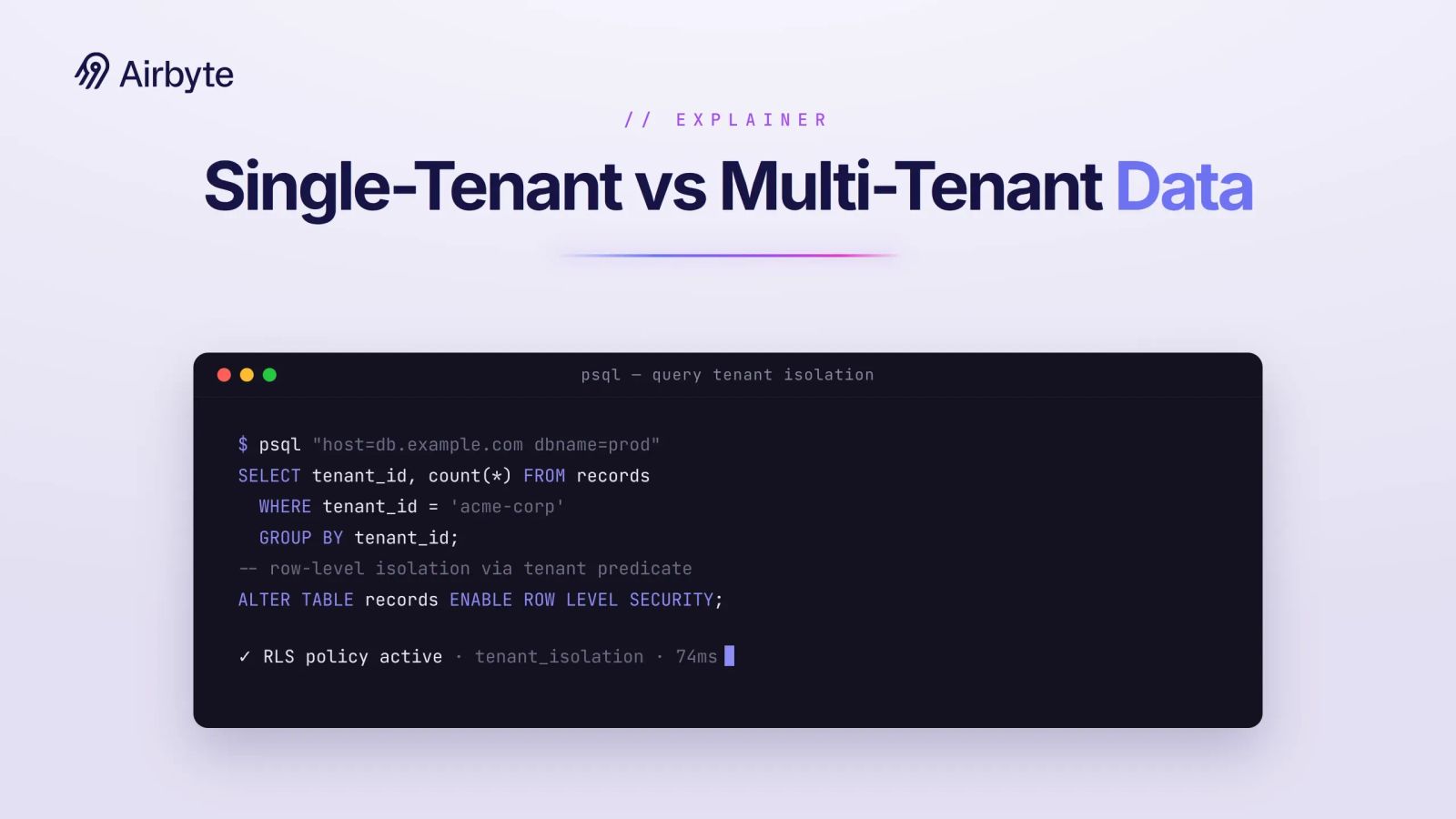
A vendor that writes "single-tenant" on your security questionnaire has told you almost nothing about where your credentials, raw records, and query logs sit. The National Institute of Standards and Technology (NIST) addresses only half of that pair in its SP 500-322 publication, defining multi-tenant as computing resources shared but logically isolated across multiple consumers; single-tenant appears nowhere in the standard. The label gains meaning only when the contract names the resources and the vendor commits to providing them.
TL;DR
- Tenancy says whether the resources holding your data are dedicated or shared.
- Silo reduces noisy-neighbor exposure with dedicated compute, storage, and network capacity, but multiplies migrations. Pool scales furthest with instrumentation; bridge adds metadata and migration overhead as tenant counts grow.
- Tenancy identifies which resources tenants share; deployment footprint identifies where processing and data handling occur. A dedicated data plane usually reports to a shared control plane, so ask which payloads, credentials, metadata, and logs cross the boundary.
- DORA assessment depends on documented controls and tested exits. HIPAA review depends on documented safeguards, compensating controls, and key ownership.
What Do Single-Tenant and Multi-Tenant Mean for Your Data?
Single-tenant generally means that some set of resources is dedicated to one customer. Multi-tenant means multiple customers share resources while their data and workloads remain logically isolated.
The problem is that those labels do not tell you which resources are dedicated or shared. A vendor might give each customer a separate database while sharing compute. Another might share a database but isolate customers by schema or row. Both could describe parts of their architecture as "dedicated."
That is why AWS uses more specific terms for SaaS architectures. A silo model gives each tenant dedicated resources, while a pool model shares resources across tenants. Database architectures often fall along the same spectrum:
- Database per tenant: Each customer has a separate database.
- Schema per tenant: Customers share a database but have separate schemas.
- Shared schema: Customers share the same tables, with a tenant identifier used to separate their rows.
AWS refers to these patterns as silo, bridge, and pool, respectively. Microsoft documents similar database patterns, while also distinguishing between tenant isolation and deployment isolation. A customer can have a dedicated deployment, for example, even if other parts of the service remain multitenant.
That distinction matters when evaluating claims about isolation. Resource pooling reduces cost by allowing customers to share infrastructure, but the isolation mechanism depends on what is being pooled. In a shared-schema database, for example, tenant boundaries may depend on every query correctly filtering by tenant ID.
So when a vendor says an environment is "dedicated," the useful follow-up is: dedicated at what layer? A dedicated database creates a stronger logical boundary than a shared schema, but neither necessarily means dedicated compute, storage, networking, or control-plane infrastructure.
How Does Tenancy Change Data Isolation?
A missing filter can leak pooled data, while a silo creates fleet-wide schema-migration risk and the bridge adds metadata and migration overhead. You are choosing which failure you would rather operate around.
In a pool, every query must carry the tenant predicate, and production traffic finds the ones that do not, making query construction part of the isolation boundary itself. The OWASP Cloud Tenant Isolation project documents cross-tenant vulnerabilities that let malicious tenants escape isolation and reach other tenants' data, above or below the database layer. Row-Level Security (RLS) moves the predicate from application code into a database policy, shrinking the bug surface, though the policy and session context still have to stay correct at runtime.
Silo trades that bug class for operational spread. The EDBT 2026 paper found that dedicated databases get patched and migrated one at a time, so an upgrade that ships once to a pool ships once per tenant across a silo fleet. Cost attribution runs the other direction: silo attributes consumption directly to a tenant, while pool needs instrumentation before anyone can say who used what. Bridge looks like a compromise until schema-per-tenant setups add metadata and complicate provisioning, patching, and migration as tenant counts climb.
AWS's Redshift multi-tenant guidance notes that Redshift did not support row-level isolation at the time of writing, so applications had to enforce it themselves, and pooled models still need Workload Management (WLM) queues to isolate compute. BigQuery treats resource management and consistent performance as a separate design dimension from access control. Pipelines carry the same noisy-neighbor problem up a layer: one tenant's bulk backfill on a shared worker pool can hold the slot another tenant's incremental sync needs, which is why both BigQuery's guidance and AWS's SaaS performance guidance call for separate data-isolation and resource-management controls.
The three isolation models trade isolation strength against operational cost along dimensions you will feel in day-to-day pipeline work.
If you cannot identify which of these six dimensions determines your choice, revisit the workload requirements.
Where Do Security and Encryption Boundaries Sit?
A dedicated database removes reliance on tenant row predicates, but authorization and routing controls still need to prevent wrong-database routing, overprivileged credentials, shared principals, and broad network access from creating their own blast-radius risks. Key custody is a separate boundary: a database dedicated to you provides no customer-controlled decryption if the vendor can still decrypt it.
Vulnerabilities in a multi-tenant SaaS application can expose one user's data to others, so logical separation still depends on the surrounding application and platform controls, not just the storage model. The OWASP Cloud Tenant Isolation project describes the same cloud-specific risk, where a malicious tenant escapes a security boundary and reaches another tenant's data. The Common Vulnerabilities and Exposures (CVE) shows what that looks like in practice: improper input validation in a BigQuery data access component in Google Cloud Apigee versions before June 12, 2026, that could let an authenticated attacker exfiltrate cross-tenant data, a failure that sits entirely outside the schema-versus-database choice. Credential compromise is a different risk: attackers with valid credentials can reach dedicated resources just as easily, so multi-factor authentication, credential rotation, network restrictions, and tenant-scoped authorization remain necessary regardless of the storage model.
Shared credentials compound the problem in dedicated setups. One database user spanning many dedicated databases widens the blast radius of an error, since an application bug can route a request to the wrong database or use overprivileged access no matter how storage is split. The same applies to shared service principals: a logic bug in one tenant's job inherits access to all of them. Audit records need the same scoping, since a log line recording "query executed" without a tenant identifier cannot tell an auditor whether tenant A's data was ever read by tenant B's job, so logging and lineage must carry tenant scope from connector to warehouse.
How Does Tenancy Differ From Deployment Footprint?
Vendors can dedicate the data plane while keeping the control plane shared. Tenancy identifies resource sharing; deployment footprint identifies where processing and data handling occur.
Databricks' architecture documentation shows one version of this: a managed control plane separated from a compute plane, with classic compute running in the customer's cloud account and serverless compute running in the provider's account, so the two planes sit on different infrastructure boundaries. In a hybrid pattern, the data plane sits in your virtual private cloud (VPC) or data center and handles processing, storing, and deleting records; which workloads sit there is its own call about data plane placement. Bring Your Own Cloud (BYOC) goes a step further, placing a dedicated data plane in the customer's account while the control plane stays vendor-operated and shared. The customer account boundary alone does not make that control plane dedicated. Air-gapped deployment footprints sit furthest along the same axis, narrowing external dependencies beyond what a standard hybrid deployment does.
Vendor documentation rarely states where credentials live; treat the SaaS column as a default to verify and ask each vendor to fill this table in writing.
How Should You Choose a Tenancy Model?
Choose pool for high tenant counts when vendors document and test the controls. Choose silo when key custody or a regulator's expectations demand a dedicated resource. Choose bridge when one dataset's regulatory profile or noisy-neighbor behavior justifies siloing it alone. The AWS SaaS Lens sorts services the same way, weighing regulatory profile and noisy-neighbor behavior against agility and cost; no model wins on every dimension.
Key custody can force the choice toward silo. Snowflake's Tri-Secret Secure feature combines a customer-held key with Snowflake-managed and cloud-provider keys, and revoking the customer-managed key stops Snowflake from decrypting data encrypted with it. Databricks announced a comparable Multi-Key Protection feature at Data + AI Summit 2025 that applies a customer-managed key per catalog, where revoking the key revokes access. No row-level policy substitutes for a key that only you control, and regions and keys govern data residency compliance on their own; a dedicated database in the wrong region still fails a residency requirement.
Regulators look for documented controls and tested exits, not a tenancy label. The Digital Operational Resilience Act (DORA), now in active enforcement, requires operational evidence across areas that tenancy alone does not define. The European Central Bank's cloud outsourcing guide names provider lock-in, auditing difficulty, concentration, sub-provider visibility, and data location as risks to assess, and those risks show up in both dedicated and pooled environments. A compliant exit depends on contracts, a documented migration strategy, portability, and evidence that critical services survive a transition; the DORA exit strategy is its own project, built on export tests and portability. For HIPAA, document the selected safeguards, compensating controls, and key owner before a reviewer asks.
How Airbyte Flex Helps Keep Tenant Data in Your Boundary
Airbyte Flex uses a hybrid deployment. Airbyte runs the control plane, including orchestration, scheduling, upgrades, and monitoring, while payload, source and destination credentials, and compute stay in your data plane. Under that hybrid control plane, only metadata and logs cross to Airbyte; records and secrets never do.
The full catalog of 700+ connectors runs in-boundary under Flex. Role-based access control (RBAC) scopes who can change each connection, audit logging records who did, and the open-source foundation lets you read and adapt the connector code that touches your data, reducing dependence on vendor-maintained code you cannot inspect.
Airbyte syncs 1.2M pipelines daily, with adoption across 20% of the Fortune 500, and its calculated return on investment sits around 239%.
Where Should You Start?
Start by asking what leaves your network. That single question determines where your credentials and raw records actually sit, no matter what a vendor's tenancy label claims.
Airbyte built Flex around that question. Its hybrid control plane handles scheduling and upgrades while credentials never leave your data plane, and audit logging records tenant-scoped activity right where the data lives.
Get a demo to see how Airbyte Flex keeps payload and credentials in your boundary while Airbyte runs the control plane.
Frequently Asked Questions
Why Should You Distrust the Term Single-Tenant?
A silo deployment can still share more than its name suggests. AWS's own silo definition notes that identity, onboarding, and day-to-day operations typically still run through shared tooling across every tenant, even when each one gets a dedicated database. Ask which of identity, onboarding, deployment tooling, and monitoring are actually dedicated to you.
Does HIPAA Require Physical Tenant Isolation?
Document the isolation model and its safeguards, assess whether the workload's risk justifies dedicated resources, and enforce the selected boundary at both the data and application layers. These controls determine how the architecture supports HIPAA compliance.
How Do Customer-Managed Keys Change the Multi-Tenant Calculus?
Snowflake's Tri-Secret Secure combines a key you hold in AWS Key Management Service (KMS), Google Cloud KMS, or Azure Key Vault with a Snowflake-managed key; if you disable your key, Snowflake cannot read your data. Databricks announced Multi-Key Protection at Data + AI Summit 2025, applying a customer-managed key per catalog where revoking that key revokes access.
What Scale Signals Should Trigger a Tenancy Migration?
Consider migration when database CPU pressure persists, storage or input/output operations per second (IOPS) reaches its limits, migration windows become unsafe, or tenant workloads no longer fit the current partitioning model. Microsoft's multitenant storage guidance recommends evaluating tenant scale, isolation, lifecycle operations, migration, recovery, and noisy-neighbor effects together, with tenant count as only one factor.

Integrate with 700+ apps using Airbyte
Move data from 700+ sources into warehouses, lakes, and beyond. Set up pipelines in minutes with pre-built connectors and the Connector Builder.