BYOC Explained: Bring Your Own Cloud for Data Infrastructure
Bring Your Own Cloud (BYOC) puts compute in your account, but the vendor still runs the control plane. Learn what metadata leaves and when BYOC beats SaaS.
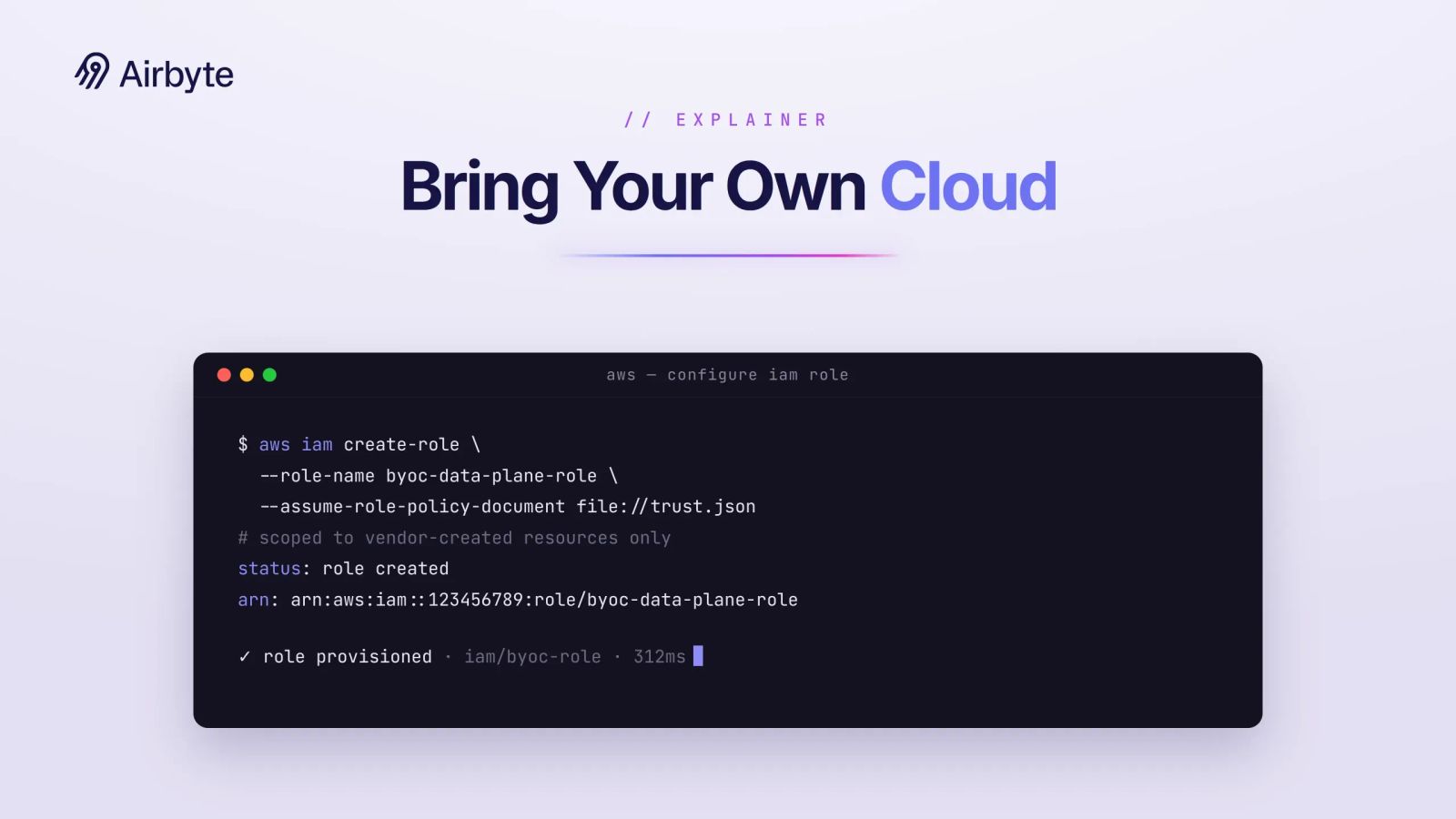
Vendors sell BYOC as the safer way to run a data platform, but account ownership alone does not make an architecture secure or sovereign. The vendor still operates the control plane, including the UI, API, scheduler, upgrades, and monitoring. Compute, storage, and workloads run inside a cloud account you own. This arrangement creates a shared trust boundary whose mechanics require careful evaluation.
TL;DR
- Vendors sell the same architecture under at least four labels: "Hybrid Deployment," "Hybrid SaaS," "Private Deployment," and "classic compute plane." The underlying architecture, not the label, identifies the model.
- Operational metadata still reaches the vendor, and legal jurisdiction may follow the vendor's corporate home, so data residency in your account alone cannot establish data sovereignty.
- Account placement does not prove security or compliance by itself; you still have to audit the vendor's role scope.
- The cloud bill, cross-availability-zone egress, IAM setup, upgrade coordination, and on-call time move to you; the vendor bills software separately.
- Choose BYOC only when you can name the residency, compliance, committed-spend, or hardware requirement that forces the data plane into your account.
What Is Bring Your Own Cloud for Data Infrastructure?
Bring Your Own Cloud for data infrastructure is a deployment model in which you provision and own the cloud account, and the vendor operates its software inside that account through a remote control plane. It sits between fully managed SaaS and running the stack yourself. Infrastructure ownership and platform operations distinguish the three models.
Platforms sell this same split under several names, including Hybrid Deployment, Hybrid SaaS, Private Deployment, and classic compute plane. Product pages may describe this architecture without using the term BYOC.
The pattern includes a control plane you do not run, a data plane in your account, and a runtime component or cross-account role connecting the two. BYOC is narrower than the hybrid deployment model, where the data plane may also run on physical hardware in your own data center. The defining question for BYOC concerns who owns and operates the infrastructure. Hybrid data integration concerns which environments a pipeline connects.
How Does a BYOC Deployment Work?
You create the account and hand the vendor a landing zone. It includes a Virtual Private Cloud (VPC), subnets, an Identity and Access Management (IAM) role or service account, object storage, quotas, and monitoring approvals. The vendor's cloud control plane then provisions its data plane there and drives it remotely. In implementations that keep records in your account, only workload metadata crosses back to the vendor.
Operational Metadata Varies by Implementation
"Metadata only" can be accurate when an implementation keeps records in your account, but the list is longer than buyers expect. Depending on the implementation, a control plane may receive topic names, partition counts, file metadata such as bucket name and size, record timestamps and offsets, and consumer group offsets. Record keys and record contents can stay in the account in such an implementation.
The Runtime Component Connects Outbound
Designs that use outbound-only encrypted channels put a management component in your account to pull its specification from the control plane. This approach keeps inbound firewall ports closed. One vendor documents a pull model in which the component retrieves a document describing the cluster's shape, so the control plane never holds credentials or excess permissions. Others run the same pattern over outbound-only mutual Transport Layer Security (mTLS) or a zero-trust tunnel scoped to orchestration traffic.
The alternative is a cross-account IAM role that the vendor's AWS account assumes. Its trust policy can include an external-ID condition. The vendor can scope its permissions to the resources it created. That pattern can be sound. A standing role with wildcard-scoped permissions is the first finding to document.
Upgrades and Outages Are Shared Events
Upgrades start on the vendor's side and land inside your change control. The vendor must therefore align with your maintenance windows and cloud-policy approvals. Depending on the implementation, the vendor may offer rolling upgrades, blue/green deployments, or canary releases.
In many BYOC implementations, the data plane can keep processing when the control plane goes down. Vendor documentation rarely states whether a control-plane outage blocks new connector or topic creation, access changes, or upgrades while data keeps flowing. Put that question in writing because the implementation-specific answer belongs in your on-call runbook.
The vendor owns control-plane availability and release engineering, while you own account security, network configuration, IAM, capacity, and the debugging that now spans two environments. The hybrid cloud security guide covers that customer half in detail.
What Does BYOC Guarantee and What Does It Leave Open?
BYOC establishes where raw data sits when the implementation keeps records in your account. It does not, by itself, establish sovereignty, compliance posture, or stronger security. The "your data never leaves" line leaves three assurances unproven.
Residency Does Not Establish Sovereignty
Data residency is a fact about servers, while data sovereignty concerns the laws that may apply to data and providers. Data may remain subject to laws outside the server's location when a provider controls it, even when the data plane runs in Frankfurt. Metadata leaving your account, such as query volume, task timing, and per-user patterns, may also appear on a vendor dashboard.
Account Placement Does Not Prove Security or Compliance
BYOC can reduce the places sensitive data crosses a vendor trust boundary, but you should not treat placement alone as proof that a deployment is more secure than well-architected SaaS. IAM exposure and data location are separate questions. Audit the vendor's role scope even when raw data stays put.
The Digital Operational Resilience Act (DORA), an EU regulation on operational resilience now in active enforcement, requires financial entities to hold tested, documented exit strategies that an account boundary cannot supply. You still need a tested process for moving configurations and workloads away from the vendor.
The Responsibility Matrix Remains Product-Specific
For deployment planning, treat the time estimates as directional and verify product-specific details with each vendor. Responsibility typically splits across the three models as follows.
If a vendor cannot explain any of these BYOC responsibilities for its own product, treat that missing explanation as the first question in your evaluation. Verify product-specific documentation before relying on these general patterns.
Who Pays for What in a BYOC Deployment?
You pay your cloud provider for compute, storage, and network, and you pay the vendor for software. That leaves two invoices and no line item tying infrastructure spend to the platform. Vendors base BYOC pricing on a software subscription, while customers still bear infrastructure expenses from the cloud provider. Sorting those charges out is FinOps work nobody budgets for.
Committed spend can provide a financial case for BYOC. This applies when your organization already has a large cloud commitment. If your infrastructure runs in your own account, it burns down an Amazon Web Services (AWS) Enterprise Discount Program (EDP) or Azure consumption commitment instead of paying a vendor to run on theirs. The EDP math may not materially change the decision unless your commitment is large enough for BYOC infrastructure spend to affect it.
No invoice captures the labor involved in IAM setup, upgrade coordination, and on-call time for a data plane you now operate. The fuller total cost of ownership model prices those hours across all three deployment options.
When Should You Choose BYOC Over SaaS or Self-Managed?
Choose BYOC when you can state, in one sentence, the residency, compliance, committed-spend, or hardware requirement that forces the data plane into your account. If you cannot write that sentence, a managed platform will usually serve you better, and the operational burden buys you nothing.
BYOC may fail that test if no platform team can debug an incident spanning two environments or if you have no committed cloud spend to burn down. It may also fail when you cannot name a requirement, since "it feels safer" does not count. Self-managed makes sense only when compliance cannot accept a vendor-run control plane with metadata access, and your team has enough staff to run the whole platform.
Once BYOC clears that bar, interrogate the vendor on the underlying mechanics. Focus your review on these questions:
- Which side initiates the connection, and over what channel?
- Which metadata fields leave the account, in writing?
- Which operations stop during a control-plane outage?
- How are upgrades proposed, approved, rolled out, and rolled back?
- Is there a published SLA for the BYOC model?
- Is the connector catalog the same across SaaS and BYOC?
The connector-parity answer also determines how much data plane flexibility you get. A gated catalog forces some workloads back to SaaS. Check parity before you commit workloads to the deployment model.
How Does Airbyte Flex Help Run Data Integration in Your Own Cloud?
Airbyte Flex is Airbyte's hybrid deployment model, built on a hybrid control plane. Airbyte operates the control plane while the data plane, along with your records, credentials, keys, and compute, runs in your environment, though some metadata such as cursor and primary-key values sits in the control plane. Your team still owns the account, network, and capacity the data plane runs on.
The full catalog of 700+ connectors runs in your boundary, and Airbyte does not gate any connector by deployment model. Airbyte builds Flex on its open-source foundation, so you can inspect and fork the code touching your data. Inspecting that code makes sovereignty a property you can verify rather than a vendor promise, and it supports portability without lock-in. The same replicated records are what an in-boundary retrieval stack indexes, so agent reads inherit the boundary and access controls the pipeline already enforces.
In production, Airbyte moves 26 billion records daily across customer deployments.
Where Should You Start?
The safest BYOC decisions start on paper. Write the one-sentence requirement that forces the data plane into your account, then require each vendor to document the responsibility split, the metadata that leaves the account, and the operations that pause during a control-plane outage. If those answers do not match your operating capacity, a managed platform usually serves you better.
Airbyte supports that operating model through Airbyte Flex, which keeps the data plane in your environment while Airbyte runs the control plane, with role-based access control and audit logging across deployment footprints. Because the connectors and data movement engine are open source, you can inspect the code that touches your data instead of trusting a contract.
Get a demo to see how Airbyte Flex deploys the full connector catalog in your boundary.
Frequently Asked Questions
Who Owns Disaster Recovery in Your BYOC Deployment?
In practice, responsibility is shared. Backups, failover, and recovery run on resources in your account, while vendor shared-responsibility documents define control-plane and customer-account duties. Write the split into the contract, including who declares an incident and who restores.
Can You Use BYOC With Customer-Managed Encryption Keys?
Confirm vendor support and document where decryption occurs during processing. Also verify who can use the keys, how access is logged, and what happens when you rotate or revoke them.
What Should You Ask Before Granting a Vendor Access to Your Account?
Ask whether vendor access is persistent, just-in-time, customer-approved, or break-glass only, and how credentials rotate after initial provisioning. Then ask which paths people can use to access the account, who logs access, and how the vendor deletes its resources and roles after termination.
Can You Run BYOC on Your Preferred Cloud Provider?
Support varies by vendor. AWS, Google Cloud, and Azure are common targets, but availability and preview status vary, so confirm the status for your provider and region.

Integrate with 700+ apps using Airbyte
Move data from 700+ sources into warehouses, lakes, and beyond. Set up pipelines in minutes with pre-built connectors and the Connector Builder.