
Summarize this article with:




Trusted by data-driven companies










Building your pipeline or Using Airbyte
Airbyte is the only open source solution empowering data teams to meet all their growing custom business demands in the new AI era.
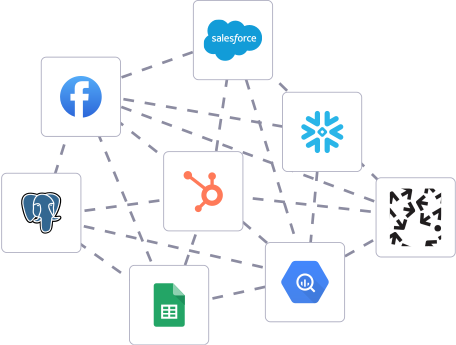
- Inconsistent and inaccurate data
- Laborious and expensive
- Brittle and inflexible
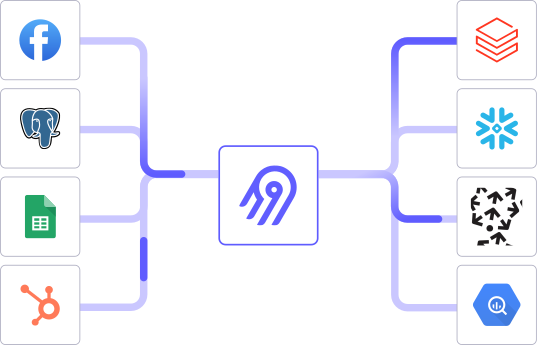
- Reliable and accurate
- Extensible and scalable for all your needs
- Deployed and governed your way
Start syncing with Airbyte in 3 easy steps within 10 minutes


Take a virtual tour
Demo video of Airbyte Cloud
Demo video of AI Connector Builder
Setup Complexities simplified!

Simple & Easy to use Interface
Airbyte is built to get out of your way. Our clean, modern interface walks you through setup, so you can go from zero to sync in minutes—without deep technical expertise.

Guided Tour: Assisting you in building connections
Whether you’re setting up your first connection or managing complex syncs, Airbyte’s UI and documentation help you move with confidence. No guesswork. Just clarity.

Airbyte AI Assistant that will act as your sidekick in building your data pipelines in Minutes
Airbyte’s built-in assistant helps you choose sources, set destinations, and configure syncs quickly. It’s like having a data engineer on call—without the overhead.
What sets Airbyte Apart
Modern GenAI Workflows
Move Large Volumes, Fast
An Extensible Open-Source Standard
Full Control & Security
Fully Featured & Integrated
Enterprise Support with SLAs
What our users say

Andre Exner

"For TUI Musement, Airbyte cut development time in half and enabled dynamic customer experiences."

Chase Zieman

“Airbyte helped us accelerate our progress by years, compared to our competitors. We don’t need to worry about connectors and focus on creating value for our users instead of building infrastructure. That’s priceless. The time and energy saved allows us to disrupt and grow faster.”

Rupak Patel

"With Airbyte, we could just push a few buttons, allow API access, and bring all the data into Google BigQuery. By blending all the different marketing data sources, we can gain valuable insights."
First, ensure that you have the Google Cloud SDK installed and configured on your local machine or server. This will allow you to interact with your Google Cloud Storage. Download and install it from the [Google Cloud SDK website](https://cloud.google.com/sdk/docs/install). Once installed, authenticate by running `gcloud auth login` and set your desired project with `gcloud config set project [PROJECT_ID]`.
Use the `gsutil` command-line tool, which comes with Google Cloud SDK, to download data from your GCS bucket. Run the command `gsutil cp gs://[BUCKET_NAME]/[OBJECT_NAME] /local/path/` to copy the data to a local directory. Make sure to replace `[BUCKET_NAME]`, `[OBJECT_NAME]`, and `/local/path/` with your actual bucket name, object key, and desired local path.
Depending on the format of the downloaded data (e.g., CSV, JSON, plain text), write a script in Python, Node.js, or another preferred language to parse and process the data. This step might involve transforming data into a format suitable for Redis, such as key-value pairs.
Ensure that Redis is installed and running on your local machine or server. You can download Redis from the [official Redis website](https://redis.io/download) and start it using the command `redis-server`. To verify it's running, use `redis-cli ping`, which should return "PONG".
Use a Redis client library in your preferred programming language to connect to your local Redis instance and write the processed data. For example, in Python, you can use the `redis` library:
```python
import redis
r = redis.StrictRedis(host='localhost', port=6379, db=0)
r.set('key', 'value')
```
Iterate through your processed data and use commands like `SET` for strings or `HSET` for hashes to store your data appropriately.
After writing the data to Redis, verify that the data has been stored correctly. Use Redis CLI commands like `GET [key]` or `HGETALL [hash_key]` to check that your data is retrievable and correct. This step ensures that the data transfer from GCS to Redis is successful and accurate.
Once you're satisfied with the manual process, automate the data transfer using a script or cron job. This automation will regularly perform the steps, such as downloading data from GCS, processing it, and writing it to Redis. Schedule a cron job on your server to execute your script at desired intervals, ensuring consistent and timely data updates. For example, add a line like `0 /usr/bin/python /path/to/script.py` to your crontab for hourly execution.
By following these steps, you can effectively move data from Google Cloud Storage to Redis without relying on third-party connectors or integrations.
FAQs
What is ETL?

ETL, an acronym for Extract, Transform, Load, is a vital data integration process. It involves extracting data from diverse sources, transforming it into a usable format, and loading it into a database, data warehouse or data lake. This process enables meaningful data analysis, enhancing business intelligence.
What is ELT?
ELT, standing for Extract, Load, Transform, is a modern take on the traditional ETL data integration process. In ELT, data is first extracted from various sources, loaded directly into a data warehouse, and then transformed. This approach enhances data processing speed, analytical flexibility and autonomy.
Difference between ETL and ELT?
ETL and ELT are critical data integration strategies with key differences. ETL (Extract, Transform, Load) transforms data before loading, ideal for structured data. In contrast, ELT (Extract, Load, Transform) loads data before transformation, perfect for processing large, diverse data sets in modern data warehouses. ELT is becoming the new standard as it offers a lot more flexibility and autonomy to data analysts.
What should you do next?
Hope you enjoyed the reading. Here are the 3 ways we can help you in your data journey:


